

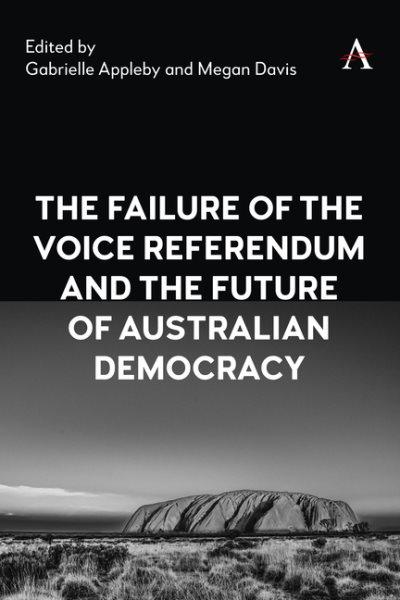
Anthem Press Failure of the Voice Referendum and the Future of Australian Democracy
GTIN: 9781839995521
This book provides the first sustained scholarly and practical analysis of the 2023 Aboriginal and Torres Strait Islander Voice referendum loss, with a view to informing the future attempts at First Nations structural reform and the practice of Australian democracy. Gabrielle Appleby is a professor of constitutional law at the UNSW Faculty of Law & Justice and is currently a Professorial Research Fellow at the Pro Vice Chancellor Society at UNSW (Sydney). She researches and teaches in public law, with her areas of expertise including the role, powers and accountability of the Executive; parliamentary law and practice; the role of government lawyers; the integrity of the judicial branch; and First Nations constitutional recognition. She is the Director of The Judiciary Project at the Gilbert + Tobin Centre of Public Law, the constitutional consultant to the Clerk of the Australian House of Representatives and a member of the Indigenous Law Centre. Gabrielle was the founding editor of Australias national public law blog, AUSPUBLAW (www.auspublaw.org). In 20152018, Gabrielle was a Chief Investigator on the ARC Discovery Project, Law, Order and Federalism, looking at the effects of the High Courts chapter III jurisprudence on State government law and order policy development. In 20162017, she worked as a pro bono constitutional adviser to the Regional Dialogues and the First Nations Constitutional Convention that led to the Uluru Statement from the Heart. Her books include Australian Public Law (4th ed., 2024); The Judge, The Judiciary and the Court: Individual, Collegial and Institutional Judicial Dynamics in Australia (2021); Judicial Federalism in Australia (2021); The Role of the Solicitor-General: Negotiating Law, Politics and the Public Interest (2016); The Critical Judgments Project: Re-reading Monis v The Queen (2016); and The Tim Carmody Affair (2016). Gabrielle has also spent time working for the Queensland Crown Solicitor and the Victorian Government Solicitors Office.Megan Davis is the Pro Vice-Chancellor Society (PVCS) at UNSW Sydney and a UNSW Scientia Professor. She holds the Balnaves Chair in Constitutional Law and the Whitlam Fraser Harvard Chair in Australian Studies at Harvard University and is a Visiting Professor at Harvard Law School. She has also been appointed a Penn Carey Law Bok Visiting International Professor, University of Pennsylvania Carey Law School (Penn Carey Law). Professor Davis is a renowned constitutional lawyer and public law expert, specialising on Indigenous peoples and the law, the constitutional recognition of First Nations and democracy. Professor Davis is a Fellow of the Australian Academy of Law, a Fellow of the Australian Academy of Social Sciences, and a Fellow of the Australian Academy of the Humanities. She is an Acting Commissioner of the NSW Land and Environment Court. She has been the leading Australian lawyer on constitutional recognition of First Nations peoples for two decades and designed the Referendum Councils deliberative process that led to the Uluru Statement from the Heart. From 2022 to 2023, she served on the Referendum Working Group, the Referendum Engagement Group and the Attorney Generals Constitutional Expert Group. She was a member of the Prime Ministers Referendum Council (20152017) and the Prime Ministers Expert Panel on the Recognition of Aboriginal and Torres Strait Islander Peoples in the Constitution (20112012). She is the Co-Chair of the Uluru Dialogue the group of First Nations leaders who led the Uluru Statement from the Heart work. Professor Davis was a Commissioner on the QLD Commission of Inquiry into Youth Detention Centres in 2016, and was the Chair and author of Family is Culture, an inquiry into NSW Aboriginal Children in Out of Home care (20172019). She is a globally recognised expert in Indigenous peoples legal rights and was elected by the UN Economic and Social Council as an expert member of the United Nations Permanent Forum on Indigenous Issues (20112016). Professor Davis was also appointed by the United Nations Human Rights Council to the Expert Mechanism on the Rights of Indigenous peoples twice (20172022). Professor Davis is a Sydney Peace Prize Laureate for the Ulu u Statement from the Heart and was awarded a 2024 PeaceWomen Award by the Womens International League for Peace & Freedom (WILPF). In 2023, Professor Davis was named on TIME Magazines TIME NEXT100 list of the Next Generation of Global leaders. She was also named Marie Claire Powerhouse of the Year in 2023. She is a previous Overall Winner of the AFR Women of Influence (now AFR Women of Leadership) awards in 2018 and was previously named on the AFR Annual Cultural Power list and AFRs Australias top 5 Legal Powerbrokers list. Australia, and Australians, stood at a crossroads in October 2023. Before them lay a new and more accommodating way to practice democracy, a future in which First Nations people were given a representative voice in political decisions in this country. After months of a referendum campaign, struggling over foundational ideals and questions of national identity, misinformation, disinformation and racism, the proposal was overwhelmingly rejected in every Australian state and nationally. The referendum campaign was Australias first since the failed attempt at a republic in 1999. The political and media environment in which the referendum campaign would unfold was fundamentally changed. These changes included the growth of social media, growing distrust of major political parties, and the rise of fake news and populist politics.This book brings together a diverse set of perspectives to explore the many and complex political, social and historical factors that influenced the conduct of the campaign and led to the loss. It includes contributions from lawyers, political scientists, historians, human rights experts, health policy experts, land rights campaigners and Indigenous affairs policy experts. The contributors in this book include First Nations and non-Indigenous authors, often writing collaboratively. The majority of the views offered, based in expertise and experience, are those of First Nations. Their writings place the referendum loss in the context of political failure and attempts at structural reform, and Australias terrible record at amending the Constitution through referendums. The book traces the legal and political development of the draft constitutional provision, and the influence of legal risk on the campaign. A major focus of the book is the impact of misinformation and disinformation, which was rife during the campaign, and media reporting of it. The role that civil society and corporate Australia played in the campaign is considered. The Voice campaign will be placed in the context of Aboriginal and Torres Strait Islander politics and previous attempts at representation. The book will also place the call for Voice in the context of its ongoing relevance and imperative in Aboriginal and Torres Strait Islander affairs, explaining the power of representation, the Voice as an expression of sovereignty, and the need for Voice to pursue other structural reforms such as treaty and to realise the promise of land rights. The book concludes by reflecting on the role that history played in the campaign and the implications of the campaign for the practice of Australian history.The book holds lessons for future constitutional change, Indigenous recognition, structural reform and Australias democracy. It also looks, with constructive pragmatism, at the future direction of First Nations structural reform in Australia and the practice of democracy. Autorid: Gabrielle Appleby, Megan Davis
Pakkumised
Tellimisel (tarne 10-14 tp) | 111,00 € | ||
Hinnapakkumised on indikatiivsed. Hinnavaatlus ei vastuta hindade, laoseisude ega tooteinfo õigsuse eest. Lõpliku hinnapakkumise tootele saab toote müüjalt. | |||

Toote tehnilised andmed
| Min. hind | 111.00 |
| Max. hind | 111.00 |
| Toode lisatud | 2026-01-19 |
Ole esimene, kes toodet kommenteerib