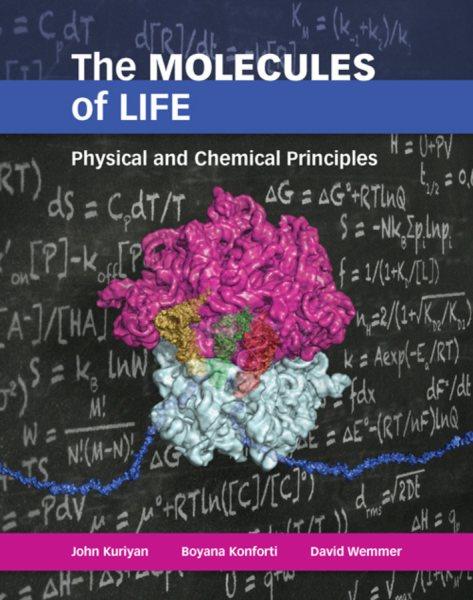
"Key to making future advances in the areas of biochemistry and molecular medicine is a new generation of molecular biologists and biochemists who are able to harness the tools and insights of physics and chemistry to exploit the emergence of genomic andsystems-level information in biology.The basic ideas of energy, entropy, equilibrium thermodynamics, transport processes and reaction kinetics are closely related to exciting issues in contemporary biology, such as protein folding, chaperones and prion diseases, DNA polymerase and ribosome fidelity, DNA recognition, drug design, signal transduction, ion channel function, motor protein action and the versatility of enzyme mechanism. Providing this physical chemistry and biochemical foundation is The "Molecules of Life", a new undergraduate textbook for undergraduate students majoring in biology or pre-med. It deepens our understanding of how life functions by illuminating the physical principles underpinning biological phenomena"--Provided by publisher. The field of biochemistry is entering an exciting era in which genomic information is being integrated into molecular-level descriptions of the physical processes that make life possible. The Molecules of Life is a new textbook that provides an integrated physical and biochemical foundation for undergraduate students majoring in biology or health sciences. This new generation of molecular biologists and biochemists will harness the tools and insights of physics and chemistry to exploit the emergence of genomics and systems-level information in biology, and will shape the future of medicine.The book integrates fundamental concepts in thermodynamics and kinetics with an introduction to biological mechanism at the level of molecular structure. The central theme is that the ways in which proteins, DNA, and RNA work together in a cell are connected intimately to the structures of these biological macromolecules. The structures, in turn, depend on interactions between the atoms in these molecules, and on the interplay between energy and entropy, which results in the remarkable ability of biological systems to self-assemble and control their own replication. The Molecules of Life deepens our understanding of how life functions by illuminating the physical principles underpinning many complex biological phenomena, including how nerves transmit signals, the actions of chaperones in protein folding, and how polymerases and ribosomes achieve high fidelity. Autorid: John Kuriyan, Boyana Konforti, David Wemmer





Ole esimene, kes toodet kommenteerib