

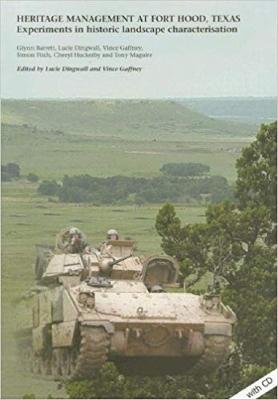
Archaeopress Heritage Management at Fort Hood, Texas: experiments in historic landscape characterisation
GTIN: 9781905739110
Historic landscape characterization was developed during the 1990s at least partly to encourage the further use of landscape architecture in heritage management. The US Army discovered that it served the Army's purpose quite well at its Texas base, and that their use of it helped develop the new field as well. Personnel working on the assignment report on the origins and aims of the project, approaches, the context of Fort Hood, the archaeological database, and the project itself. There is no index. The disk contains maps and other images. Distributed in North America by The David Brown Book Company. Annotation ©2007 Book News, Inc., Portland, OR (booknews.com) The landscape of Fort Hood, in central Texas, presents archaeologists and cultural resource managers with some of their most exacting but absorbing challenges. That much is clear from the activities of the many archaeologists and heritage managers who have sought to use the extensive cultural database and unique landscape of the base as a test bed for research and management methodologies. This project, carried out as an international collaboration between the Fort Hood Cultural Resource Management Team and the Institute of Archaeology and Antiquity (University of Birmingham, UK), sought to provide a novel application of historic landscape characterisation (HLC) methodologies at the base. For decades, the effective stewardship and management of cultural resources at Fort Hood, Texas, has proven to be a formidable challenge. Balancing this responsibility with the Army mission at Fort Hood, which includes ongoing intensive mechanized training across a 217,000-acre military reservation, has tested the abilities of even the most capable of cultural resource managers. The identification of over 2,000 archaeological sites on the installation, while a great accomplishment, pales in comparison to the demands of determining site significance. Now, with this innovative historic landscape characterization study, the authors have presented us with an extraordinary opportunity to view these resources within the context of a cultural landscape that systematically considers the multiple roles of Fort Hood. It is hoped that this will facilitate the move from significance determinations that are site-specific to ones based upon, as the authors state, the concepts of group value and spatial relationships at a landscape level. The accompanying CD (displaying selected data layers provided as Google Earth layers) assists readers in viewing and interpreting the data and the value of HLC procedures and output for the purposes of heritage management. Contents: 1. The Origins and Aims of the Fort Hood Historic Landscape Characterisation Project; 2) Approaches to historic landscape characterisation; 3) Fort Hood in Context; 4) The Fort Hood archaeological database; 5) The historic landscape characterisation project. The landscape of Fort Hood, in central Texas, presents archaeologists and cultural resource managers with some of their most exacting but absorbing challenges. That much is clear from the activities of the many archaeologists and heritage managers who have sought to use the extensive cultural database and unique landscape of the base as a test bed for research and management methodologies. This project, carried out as an international collaboration between the Fort Hood Cultural Resource Management Team and the Institute of Archaeology and Antiquity (University of Birmingham, UK), sought to provide a novel application of historic landscape characterisation (HLC) methodologies at the base. For decades, the effective stewardship and management of cultural resources at Fort Hood, Texas, has proven to be a formidable challenge. Balancing this responsibility with the Army mission at Fort Hood, which includes ongoing intensive mechanized training across a 217,000-acre military reservation, has tested the abilities of even the most capable of cultural resource managers. The identification of over 2,000 archaeological sites on the installation, while a great accomplishment, pales in comparison to the demands of determining site significance. Now, with this innovative historic landscape characterization study, the authors have presented us with an extraordinary opportunity to view these resources within the context of a cultural landscape that systematically considers the multiple roles of Fort Hood. It is hoped that this will facilitate the move from significance determinations that are site-specific to ones based upon, as the authors state, the concepts of group value and spatial relationships at a landscape level. The accompanying CD (displaying selected data layers provided as Google Earth layers) assists readers in viewing and interpreting the data and the value of HLC procedures and output for the purposes of heritage management. Carried out as an international collaboration between the Fort Hood Cultural Resource Management Team and the Institute of Archaeology and Antiquity (University of Birmingham, UK), this project provides a novel application of historic landscape characterisation (HLC) methodologies at the base. Autorid: Glynn Barrett, Lucie Dingwall, Vincent Gaffney
Pakkumised
Tellimisel (tarne 10-14 tp) | 29,99 € | ||
Hinnapakkumised on indikatiivsed. Hinnavaatlus ei vastuta hindade, laoseisude ega tooteinfo õigsuse eest. Lõpliku hinnapakkumise tootele saab toote müüjalt. | |||

Toote tehnilised andmed
| Min. hind | 29.99 |
| Max. hind | 29.99 |
| Toode lisatud | 2026-04-26 |
Ole esimene, kes toodet kommenteerib