L'Immoraliste est un récit d'André Gide publié en 1902. Il raconte l'inversion de la conscience morale survenue chez le héros à la suite d'une maladie et d'un retour à la santé qui bouleverse sa physiologie.L'auteur l'a conçu comme le pendant d'un autre récit, La Porte étroite, qu'il a rédigé concurremment.Cette oeuvre peut se lire dans une perspective autobiographique. De la même manière que le personnage découvre son corps au détour de la tuberculose, André Gide fait une découverte la même année, celle de son homosexualité. Il n'ose l'évoquer explicitement, c'est pourquoi il s'appuie sur les théories esthétiques symbolistes pour en faire une métaphore au travers du caractère allégorique de l'oeuvre, donnant lieu également à la possibilité d'une multitude de lectures.L'oeuvre paraît en 1902. André Gide est alors âgé de 33 ans, mais celui-ci est encore peu connu en dehors des milieux littéraires. Le livre reçoit un accueil plutôt positif, malgré l'aspect scabreux du récit. Gide se verra donner une réputation d'immoraliste au tournant d'un contresens autour de l'oeuvre, ce qui ne déplaira pas pour autant à son auteur.Elle recevra tout de même de vives critiques, de même que Les Caves du Vatican (1914) et les Faux-Monnayeurs qui suivent en 1925, notamment de Henri Massis et de Henri Béraud. Ils l'accusent inlassablement de pervertisseurs de la jeunesse, et jugent les sujets qu'ils abordent dans ses fictions de scabreux, tel que la pédérastie.
R sum Si les toiles du c l bre F lix Valloton (1865-1925) frappent par leurs couleurs profondes, son roman La vie meurtri re, r dig entre 1907 et 1908 et publi de mani re posthume en 1927, est impr gn d'une inqui tante noirceur. Jacques Verdier, artist
Cairo 1925, Haret al-Yahud, the old Jewish Quarter. Esther, a beautiful young woman believed to be possessed by demons, longs to give birth after seven blissful years of marriage. Her husband, blind since childhood, does not object when, in her effort to conceive, she participates in Muslim zar rituals. Zohar, the novel&;s narrator, comes into the world, but because his mother&;s breasts are dry, he is nursed by a Muslim peasant&;also believed to be possessed&;who has just given birth to a girl, Masreya. Suckled at the same breasts and united by a rabbi&;s amulet, the milk-twins will be consumed by a passionate, earth-shaking love. Part fantastical fable, part realistic history, A Land Like You draws on ethno-psychiatrist Tobie Nathan&;s deep knowledge of North African folk beliefs to create a glittering tapestry in which spirit possession and religious mysticism exist side by side with sober facts about the British occupation of Egypt and the rise of the Muslim Brotherhood and the Free Officers&; Movement. Historical figures such as Gamel Abdel Nasser, Anwar Sadat, and King Farouk mingle with Nathan&;s fictional characters in this riveting and revealing tale of an Egypt caught between tradition and modernity, multiculturalism and nationalism, oppression and freedom. <br><br> Autorid: Tobie Nathan, Joyce Zonana <br>
September, 1925. Mary Russell and Sherlock Holmes are looking forward to spending time with Holmes' son, the famous artist Damian Adler, and his family in the French countryside. But on their arrival, they discover that the Adlers have fled from a mysterious threat. In the ominously empty house, Russell discovers clues including an old journal written in a nearly impenetrable code. As she delves deeper, it appears that the secrets of the past are reaching into the present. Could there be things about Holmes' own history that even the master detective does not perceive? <br><br> Autorid: Laurie R. King <br>
GTIN: 9782379662102Eclectic & esoteric religions & belief systems
Titre majeur de René Guénon, avec « La crise du monde moderne », cet ouvrage expose et dénonce clairement le matérialisme, le règne de l’argent, l’effacement de l’identité de toutes choses au nom de la quantité, des statistiques, de cette course en avant perpétuelle où les valeurs profondes sont oubliées et où la perte de sens amène la perdition de l’âme dans des dédales sombres. C’est le Kali Yuga. Erreurs, errances et mensonges du monde moderne sont analysés et disséqués, à la lumière de principes métaphysiques d’une rare rigueur.Écrit à la fin de la Seconde Guerre mondiale, ce texte est et reste visionnaire, presque un siècle plus tard.Auteur français de 27 ouvrages (dont 10 recueils d’articles à titre posthume), René Guénon est une figure hors-norme de la spiritualité et de l’ésotérisme du XXe siècle. Né le 15 novembre 1886 à Blois (France), dans une famille catholique, et mort musulman (soufi) le 7 janvier 1951 au Caire, en Égypte, il poursuivra toute sa vie la quête de la Connaissance, la métaphysique traditionnelle, et dénoncera les errements des sciences occultes et la rupture de l’Occident avec la vie spirituelle authentique. Il collaborera à de nombreuses publications consacrées à ces thèmes, et particulièrement, dès 1925, à la revue Le Voile d’Isis (renommée ensuite Études traditionnelles).
Novelist, playwright, film actor, martial artist, and political commentator, Yukio Mishima (1925-1970) was arguably the most famous person in Japan at the time of his death. Henry Scott Stokes, one of Mishima's closest friends, was the only non-Japanese allowed to attend the trial of the men involved in Mishima's spectacular suicide. In this insightful and empathetic look at the writer, Stokes guides the reader through the milestones of Mishima's meteoric and eclectic career and delves into the artist's major works and themes. This biography skillfully and compassionately illuminates the achievements and disquieting ideas of a brilliant and deeply troubled man, an artist of whom Nobel Laureate Yasunari Kawabata had said, "A writer of Mishima's caliber comes along only once every two or three hundred years."
Containing a wealth of material on a variety of subjects, Light for the New Millennium tells the story of the meeting of two great men and their continuing relationship beyond the threshold of death: Rudolf Steiner (1861-1925) - the seer, scientist of the spirit, and cultural innovator - and Helmuth von Moltke (1848-1916) - a renowned military man, Chief of the General Staff of the German army during the outbreak of the First World War. In 1914, following disagreements with the Kaiser, Moltke was dismissed from his post. This led to a great inner crisis in the General, that in turn drew him closer to Steiner. When Moltke died two years later, Steiner maintained contact with his excarnated soul, receiving communications that he passed on to Moltke's wife, Eliza. These remarkable and unique messages are reproduced here in full, together with relevant letters from the General to his wife. The various additional commentaries, essays and documents give insights to themes of continuing significance for our time, including the workings of evil; karma and reincarnation; life after death; the new millennium and the end of the last century; the hidden causes of the First World War; the destiny of Europe, and the future of Rudolf Steiner's science of the spirit. Also included are Moltke's private reflections on the causes of the Great War ('the document that could have changed world history'), a key interview with Steiner for Le Matin, an introduction and notes by T. H. Meyer, and studies by Jurgen von Grone, Jens Heisterkamp and Johannes Tautz. <br><br> Autorid: Rudolf Steiner, Helmuth von Moltke, Eliza von Moltke, T. H. Meyer <br>
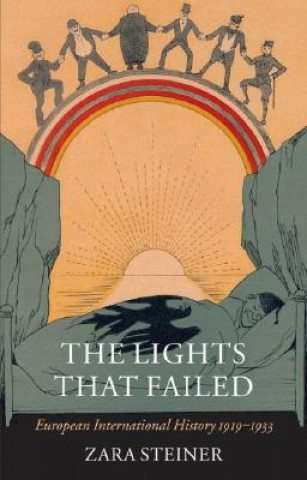
The peace treaties represented an almost impossible attempt to solve the problems caused by a murderous world war. In The Lights that Failed: European International History 1919-1933, part of the Oxford History of Modern Europe series, Steiner challenges the common assumption that the Treaty of Versailles led to the opening of a second European war. In a radically original way, this book characterizes the 1920s not as a frustrated prelude to a second global conflict but as a fascinating decade in its own right, when politicians and diplomats strove to re-assemble a viable European order. Steiner examines the efforts that failed but also those which gave hope for future promise, many of which are usually underestimated, if not ignored. She shows that an equilibrium was achieved, attained between a partial American withdrawal from Europe and the self-imposed constraints which the Soviet system imposed on exporting revolution. The stabilization painfully achieved in Europe reached it fragile limits after 1925, even prior to the financial crises that engulfed the continent.The hinge years between the great crash of 1929 and Hitler's achievement of power in 1933 devastatingly altered the balance between nationalism and internationalism.This wide-ranging study helps us grasp the decisive stages in this process. In a second volume, The Triumph of the Night Steiner will examine the immediate lead up to the Second World War and its early years.
<p>DISNEY "WISH" kosmeetikakomplekt pakitud armsasse kosmeetikakotti.</p><p><span style="font-weight:bold;">Toote omadused:</span></p><ul><li>Komplektis on palju huulehooldustooteid, mis niisutavad huuli ja muudavad need kaunimaks.</li><li>Komplekti kuuluvad ka aksessuaarid - ripats ja sõrmus.</li></ul>
In 1925, Fernando Pessoa wrote a guidebook to Lisbon for English-speaking visitors, and wrote it in English. The typescript was only discovered amongst his papers long after his death, but has not hitherto been made available in the UK or the USA. The book is fascinating in that it shows us Pessoa's view of his native city - and Pessoa, as an adult, rarely left Lisbon, and it figures large in his poetry. The book can still be useful to visitors today, given that the majority of the sights described are still to be found. A fascinating scrap from the master's table....
From its very beginning Christianity not only had the message but, in the sacrament, an experience of the essence. Christianity lived for some time without the New Testament, which first had to be written. But it never lived without the Eucharist. Rudolf Frieling Building on his existing works of contemporary Christian research, Living Renewal gathers Rudolf Frielings previously-untranslated articles and essays on the nature and practise of Christian worship and the mysteries of Johns Gospel. Harvested from his entire career, the collection begins with an early piece entitled The Destruction of the Temple and the End of the World and is followed by dozens of studies listed under the headings of Sacred Playing, Prayer and the Renewed Sacrament, Sacred Number in Johns Gospel, Studies on the Mass and Contributions on the Epistles (Seasonal Prayers). Frielings writings are complemented with essays by Friedrich Rittelmeyer and Hermann Beckh both close colleagues and appreciations by fellow theologians. This original publication essential reading for anyone interested in modern theology is a welcome addition to Christian Community literature. <br><br> Autorid: Rudolf Frieling, Maren & Alan Stott <br>