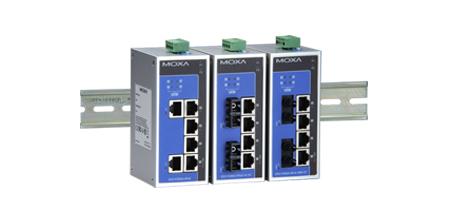
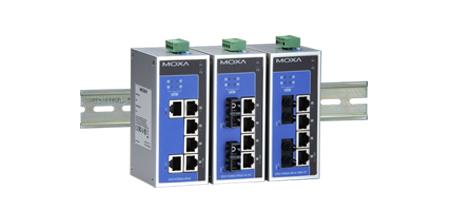
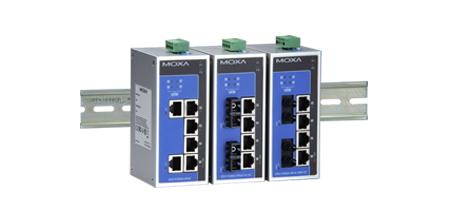
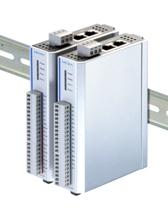
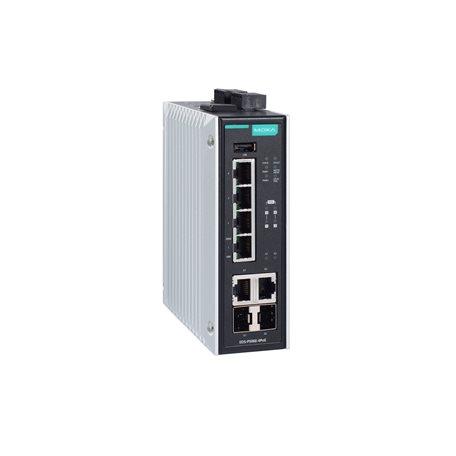
Features and Benefits 4 IEEE 802.3at compliant PoE and Ethernet combo ports Up to 30 watts at 24/48 VDC per PoE port Intelligent power consumption detection and classification Redundant dual VDC power inputs -40 to 75°C operating temperature range (T models) Introduction The EDS-P206A-4PoE switches are smart, 6-port, unmanaged Ethernet switches supporting PoE (Power-over-Ethernet) on ports 1 to 4. The switches are classified as power source equipment (PSE), and when used in this way, the EDS-P206A-4PoE switches enable centralization of the power supply and provide up to 30 watts of power per port. The switches can be used to power IEEE 802.3at compliant powered devices (PD), eliminating the need for additional wiring, and support IEEE 802.3/802.3u/802.3x with 10/100M, full/half-duplex, MDI/MDI-X auto-sensing to provide an economical solution for your industrial Ethernet network. In addition, the built-in relay warning function alerts network engineers when power failures or port breaks occur.
Features and Benefits 4 IEEE 802.3at compliant PoE and Ethernet combo ports Up to 30 watts at 24/48 VDC per PoE port Intelligent power consumption detection and classification Redundant dual VDC power inputs -40 to 75°C operating temperature range (T models) Introduction The EDS-P206A-4PoE switches are smart, 6-port, unmanaged Ethernet switches supporting PoE (Power-over-Ethernet) on ports 1 to 4. The switches are classified as power source equipment (PSE), and when used in this way, the EDS-P206A-4PoE switches enable centralization of the power supply and provide up to 30 watts of power per port. The switches can be used to power IEEE 802.3at compliant powered devices (PD), eliminating the need for additional wiring, and support IEEE 802.3/802.3u/802.3x with 10/100M, full/half-duplex, MDI/MDI-X auto-sensing to provide an economical solution for your industrial Ethernet network. In addition, the built-in relay warning function alerts network engineers when power failures or port breaks occur.
Features and Benefits 4 IEEE 802.3at compliant PoE and Ethernet combo ports Up to 30 watts at 24/48 VDC per PoE port Intelligent power consumption detection and classification Redundant dual VDC power inputs -40 to 75°C operating temperature range (T models) Introduction The EDS-P206A-4PoE switches are smart, 6-port, unmanaged Ethernet switches supporting PoE (Power-over-Ethernet) on ports 1 to 4. The switches are classified as power source equipment (PSE), and when used in this way, the EDS-P206A-4PoE switches enable centralization of the power supply and provide up to 30 watts of power per port. The switches can be used to power IEEE 802.3at compliant powered devices (PD), eliminating the need for additional wiring, and support IEEE 802.3/802.3u/802.3x with 10/100M, full/half-duplex, MDI/MDI-X auto-sensing to provide an economical solution for your industrial Ethernet network. In addition, the built-in relay warning function alerts network engineers when power failures or port breaks occur.
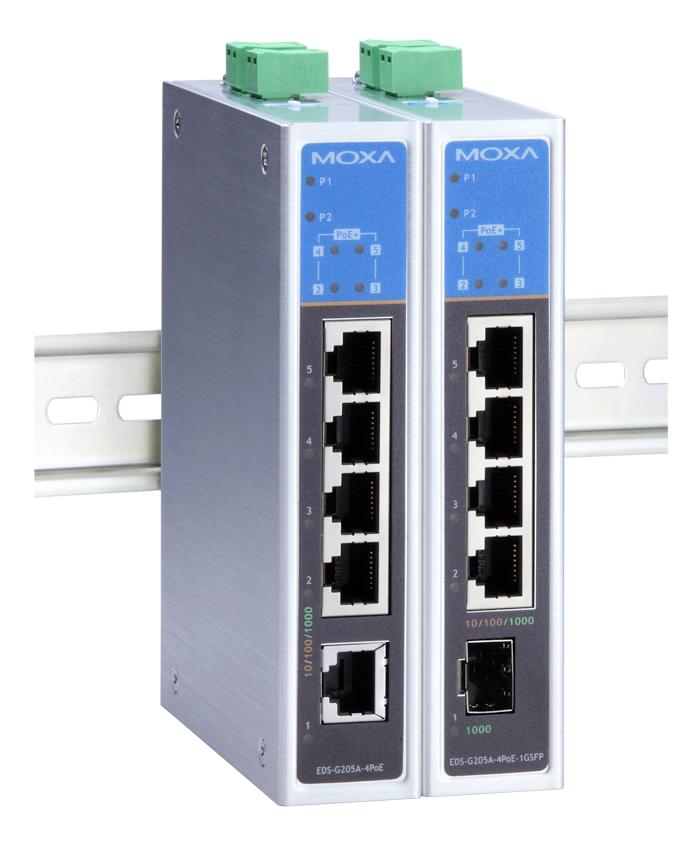
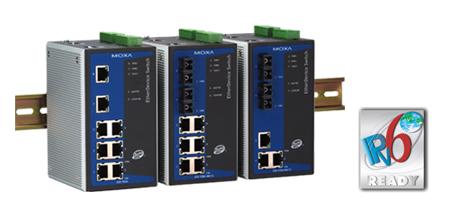
Features and Benefits Full-gigabit Ethernet ports IEEE 802.3af/at, PoE/PoE+ standards Up to 30 watts output per PoE port 24/48 VDC flexible redundant power inputs Intelligent power consumption detection and classification Smart PoE over current and short circuit protection -40 to 75°C operating temperature range (T models) Introduction The EDS-G205A-4PoE switches are smart, 5-port, unmanaged full-gigabit Ethernet switches supporting Power-over-Ethernet on ports 2 to 5. The switches are classified as power source equipment (PSE), and when used in this way, the EDS-G205A-4PoE switches enable centralization of the power supply, providing up to 30 watts of power per port and reducing the effort needed for installing power. The switches can be used to power IEEE 802.3af/at standard devices (PD), eliminating the need for additional wiring, and they support IEEE 802.3/802.3u/802.3x with 10/100/1000M, full/half-duplex, MDI/MDI-X auto-sensing to provide an economical high-bandwidth solution for your industrial Ethernet network.
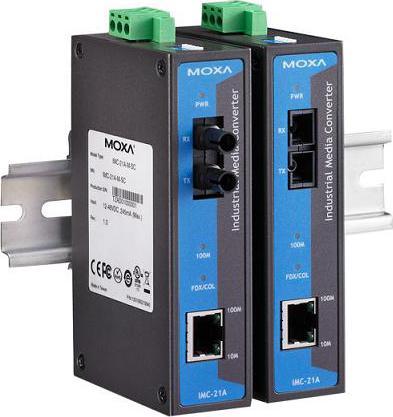
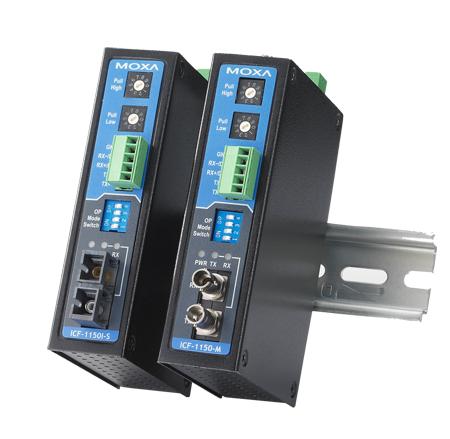
Features and Benefits Multi-mode or single-mode, with SC or ST fiber connector Link Fault Pass-Through (LFP) -40 to 75°C operating temperature range (T models) DIP switches to select FDX/HDX/10/100/Auto/Force Introduction The IMC-21A industrial media converters are entry-level 10/100BaseT(X) to 100BaseFX media converters designed to provide reliable and stable operation in harsh industrial environments. The converters can operate reliably in temperatures ranging from -40 to 75°C. The rugged hardware design ensures that your Ethernet equipment can withstand demanding industrial conditions. The IMC-21A converters are easy to mount on a DIN-Rail or in distribution boxes.
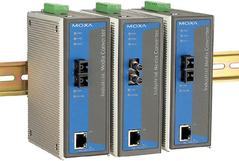
Features and Benefits 10/100BaseT(X) auto-negotiation and auto-MDI/MDI-X Link Fault Pass-Through (LFP) (media converters should work as a pair) Power failure, port break alarm by relay output Redundant power inputs -40 to 75°C operating temperature range (T models) Designed for hazardous locations (Class 1 Div. 2/Zone 2) Introduction The IMC-101 industrial media converters provide industrial grade media conversion between 10/100BaseT(X) and 100BaseFX (SC/ST connectors). The IMC-101’s reliable industrial design is excellent for keeping your industrial automation applications running continuously, and each IMC-101 converter comes with a relay output warning alarm to help prevent damage and loss. The IMC-101 media converters are designed for harsh industrial environments, such as in hazardous locations (Class 1, Division 2/Zone 2, DNV, and GL Certification), and comply with FCC, TV, UL, and CE standards. The IMC-101 series is available in models that support an operating temperature of 0 to 60?C, and an extended operating temperature of -40 to 75?C. All IMC-101 series are subjected to a 100% burn-in test.
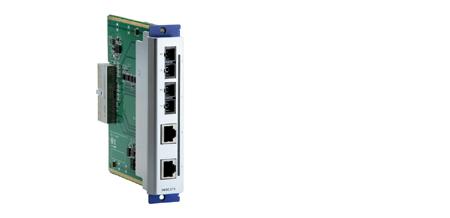
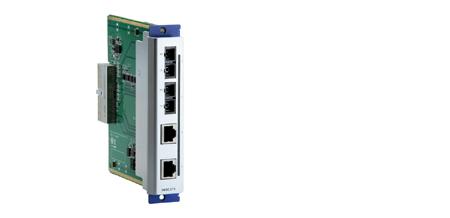
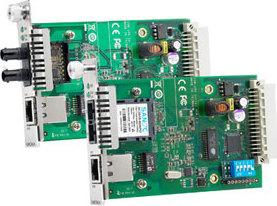
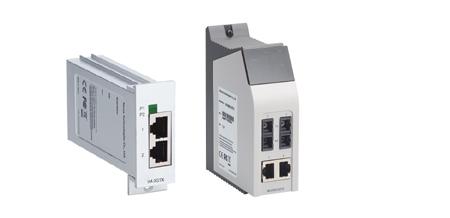
Features and Benefits LFP (Link Fault Pass-through) and FEF (Far End Fault) Two different operation modes · Store-and-Forward · Pass Through Auto Negotiation Supports TS-1000 Version 2 protocol Supports Turbo Ring V2 Plug and Play Hot-swap Introduction The CSM-200 modules are slide-in Ethernet-to-fiber media converters for the NRack System™. The modules provide media conversion from 10/100BaseT(X) to 100BaseFX (SC/ST connectors), and can be installed in any NRack System™ chassis.
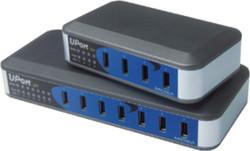
Features and Benefits > Hi-Speed USB 2.0 for up to 480 Mbps USB transmission > USB-IF Certification > Compatible with USB 1.1 devices > 15 KV ESD Level 4 protection for all USB ports > Wall mountable > Comprehensive diagnostic LEDs > Full 500 mA of power per port > Choose bus power or external power (UPort™ 204 only) Introduction The UPort™ 204 and UPort™ 207 are entry-level USB 2.0 hubs that expand 1 USB port into 4 and 7 USB ports, respectively. The hubs are designed to provide true USB 2.0 Hi-Speed 480 Mbps data transmission through each port, even for heavy-load applications. The UPort™ 204/207 have received USB-IF Hi-Speed certification, which is an indication that both products are reliable, high quality USB 2.0 hubs. In addition, the hubs are fully compliant with the USB Plug & Play spec and provide a full 500 mA of power per port, ensuring that your USB devices will function properly. The UPort™ 204/207 hubs" support of 12-40 VDC power makes them ideal for mobile applications. Externally powered USB hubs are the only way to guarantee the broadest compatibility with USB devices. USB-IF Certification The UPort™ 204/207 USB 2.0 entry-level USB hubs have passed USB-IF (USB Implementers Forum) certification. USB-IF verifies a number of strict electrical requirements for the Hi-Speed USB operation of USB hubs designed to the USB 2.0 specification. This means that the UPort™ 204/207 support Hi-Speed USB 2.0 for up to 480 Mbps USB transmission, which is fully compliant with interoperability requirements, is enough power for devices to function, and provides for a successful transition back to high-speed operation from the suspend state. ESD Level 4 Protection Electrostatic discharge (ESD) could be as severe as having more than one thousand volts of ESD with a high rise time (dv/dt) break through the junction layer of protective devices. In order to avoid serious damage, Moxa's UPort™ 204/207 USB hubs provide ESD level 4 (contact 8 KV, air 15 KV) protection, which increases the quality and
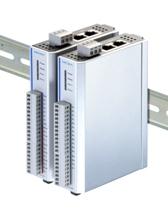
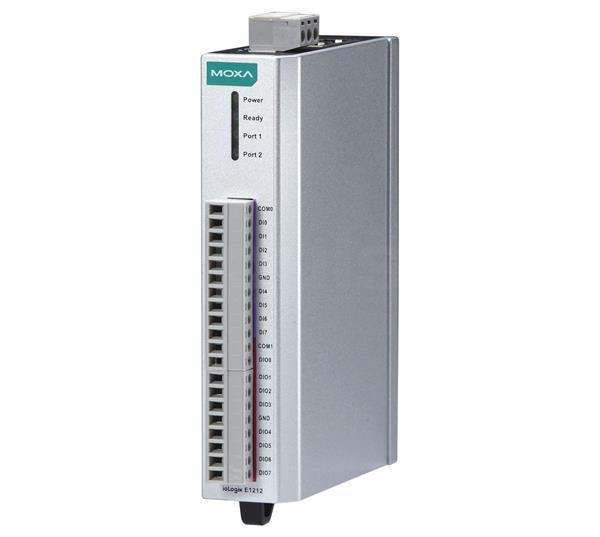
Features and Benefits Built-in 2-port Ethernet switch for daisy-chain topologiesFree support of Moxa’s push-based Active OPC Server Lite- Seamlessly connect to any SCADA system- Save 80% on network bandwidth- I/O response that’s seven times fasterUser-defined Modbus/TCP addressingI/O peer-to-peer functionMXIO programming library for Windows and WinCE VB/VC.NET and Linux C APIsWeb configuration with Import/Export functionWide temperature models (-40 to 75°C) are availableIntroductionDaisy-chained Ethernet I/O ConnectionA new daisy-chained Ethernet I/O concept is now available. The ioLogik E1211 industrial Ethernet remote I/O has two embedded Ethernet switch ports that allow information to flow to another local Ethernet device or connect to the next ioLogik in the daisy-chain.Applications such as factory automation, security and surveillance systems, and tunnel monitoring, can make use of daisy-chained Ethernet for building multi-drop I/O networks over standard Ethernet cables. Many industrial automation users are familiar with the multi-drop configuration typically used in fieldbus applications. The daisy-chain function on the Ethernet remote I/O ioLogik E1211 not only increases the connection between machines and panels, but also lowers the cost of buying separate Ethernet switches, and at the same time reduces labor fees and cabling by a large percentage. For example, if a production facility contains 700 stations (20 points per station), the wiring cost reduction can reach 15% of the total implementation cost.Saving Time and Wiring Costs with Peer-to-Peer CommunicationsIn remote automation applications, the control room and sensors are often far removed, making wiring over long distances a constant challenge. With peer-to-peer networking, users may now map a pair of ioLogik E1200 series modules so that input values will be directly transferred to output channels, greatly simplifying the wiring processand reducing wiring costs.User-definable Modbus/TCP Addressing for Painless Upgrading of Existing SystemsFo
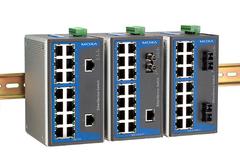
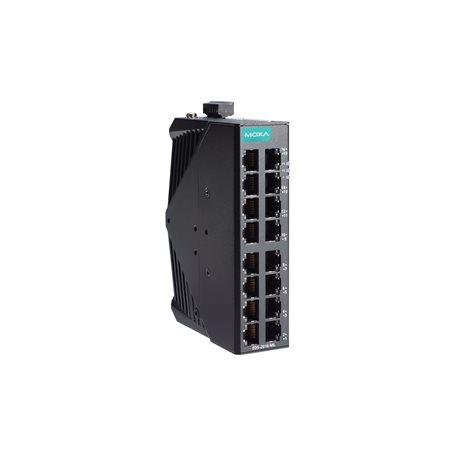
Features and Benefits10/100BaseT(X) (RJ45 connector), 100BaseFX (multi/single-mode, SC or ST connector) Redundant dual 12/24/48 VDC, 18 to 30 VAC power inputsIP30 aluminum housingRugged hardware design well suited for hazardous locations (Class I Div. 2 /ATEX) and maritime environments (DNV/GL)-40 to 75°C operating temperature range (T models)IntroductionThe EDS-205A/208A series are 5 and 8-port industrial Ethernet switches that support IEEE 802.3 and IEEE 802.3u/x with 10/100M full/half-duplex, MDI/MDI-X auto-sensing. The EDS-205A/208A switches provide 12/24/48 VDC (9.6 to 60 VDC), 18 to 30 VAC redundant power inputs that can be connected simultaneously to live AC/DC power sources. These switches have been designed for harsh industrial environments, such as in maritime (DNV/GL) or hazardous locations (Class I Div. 2, ATEX Zone 2) that comply with FCC, TUV, UL, and CE standards.The EDS-205A/208A switches are available with a standard operating temperature range from -10 to 60°C, or with a wide operating temperature range from -40 to 75°C. All models are subjected to a 100% burn-in test to ensure that they fulfill the special needs of industrial automation control applications. In addition, the EDS-205A/208A switches have DIP switches for enabling or disabling broadcast storm protection, providing another level of flexibility for industrial applications.
User-definable Modbus TCP Slave addressing Supports RESTful API for IIoT applications Supports EtherNet/IP Adapter 2-port Ethernet switch for daisy-chain topologies Saves time and wiring costs with peer-to-peer communications Active communication with MX-AOPC UA Server Supports SNMP v1/v2c Easy mass deployment and configuration with ioSearch utility Friendly configuration via web browser Simplifies I/O management with MXIO library for Windows or Linux Class I Division 2, ATEX Zone 2 certification Wide operating temperature models available for -40 to 75°C (-40 to 167°F) environments Introduction The ioLogik E1200 Series supports the most often-used protocols for retrieving I/O data, making it capable of handling a wide variety of applications. Most IT engineers use SNMP or RESTful API protocols, but OT engineers are more familiar with OT-based protocols, such as Modbus and EtherNet/IP. Moxa's Smart I/O makes it possible for both IT and OT engineers to conveniently retrieve data from the same I/O device. The ioLogik E1200 Series speaks six different protocols, including Modbus TCP, EtherNet/IP, and Moxa AOPC for OT engineers, as well as SNMP, RESTful API, and Moxa MXIO library for IT engineers. The ioLogik E1200 retrieves I/O data and converts the data to any of these protocols at the same time, allowing you to get your applications connected easily and effortlessly. Daisy-Chained Ethernet I/O Connection This industrial Ethernet remote I/O comes with two switched Ethernet ports to allow for the free flow of information downstream to another local Ethernet device, or upstream to a control server via expandable daisy-chained Ethernet I/O arrays. Applications such as factory automation, security and surveillance systems, and tunneled connections can make use of daisy-chained Ethernet for building multidrop I/O networks over standard Ethernet cables. Many industrial automation users are familiar with multidrop as the configuration most typically used in fieldbus solutions. The daisy-chain capabilities supported by ioLogik Ethernet remote I/O units not only increase the expandability and installation possibilities for your remote I/O applications, but also lower overall costs by reducing the need for separate Ethernet switches. Daisy-chaining devices in this way will also reduce overall labor and cabling expenses. Save Time and Wiring Costs with Peer-to-Peer Communications In remote automation applications, the control room and sensors are often far removed, making wiring over long distances a constant challenge. With peer-to-peer networking, users may now map a pair of ioLogik Series modules so that input values will be directly transferred to output channels, greatly simplifying the wiring process and reducing wiring costs. User-Definable Modbus TCP Addressing for Painless Upgrading of Existing Systems For Modbus devices that are controlled and detected by fixed addresses, users need to spend a vast amount of time researching and verifying initial configurations. Users need to locate each device’s networking details, such as I/O channels or vendor-defined addresses, to enable the initial or start address of a SCADA system or PLC. Devices that support user-definable Modbus TCP addressing offer greater flexibility and easier setup. Instead of worrying about individual devices, users simply configure the function and address map to fit their needs. Push Technology for Events When used with MX-AOPC UA Server, devices can use active push communications when communicating changes in state and/or events to a SCADA system. Unlike a polling system, when using a push architecture for communications with a SCADA system, messages will only be delivered when changes in state or configured events occur, resulting in higher accuracy and lower amounts of data that need to be transferred.
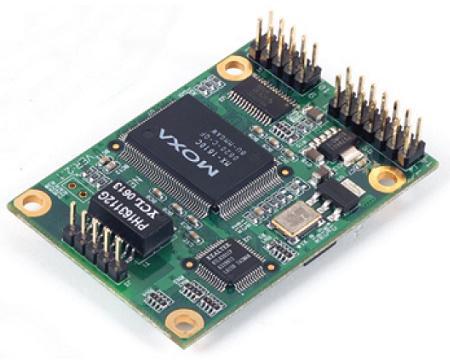
Features and Benefits 10/100 Mbps Ethernet interface Up to 230.4 Kbps baudrate support Choice of operation modes: Real COM, TCP Server, TCP Client, and UDP DHCP, BootP, Static IP, and ARP supported SNMP and e-mail alerts for event trapping and notifi cation Half the size of a credit card—only 57 × 40 mm Low power consumption at 1.5W, with single +5V input Overview Moxa´s NE-4100 embedded device servers are designed for manufacturers who want to add sophisticated network connectivity to their serial devices. Moxa´s embedded device servers can be used to convert any device with a standard serial interface to an Ethernet enabled device in no time. The NE-4100 embedded device servers support 10/100 Mbps Ethernet, and provide ready-to-use operation modes, including TCP Server, TCP Client, and UDP. In addition, a Real COM driver is included for backward compatibility with legacy software. • Form Factor Type Ready-to-go stand-alone modules Dimensions 57 × 40 mm (2.24 x 1.57 in) • LAN Interface Number of Ports 1 Speed 10/100 Mbps, Auto MDI/MDIX Connector(s) 5-pin pin header Magnetic Isolation Protection 1.5 KV built-in • Serial Interface Serial Standards Port1: RS-232 Port 2: Serial (TTL) console port Number of Ports 2 RS-485 Data Direction Control ADDC® (Automatic data direction control) • Serial Signals RS-232 TxD, RxD, RTS, CTS, DTR, DSR, DCD, GND TTL (Port 2) TxD, RxD, GND • Serial Communication Parameters Data Bits 5, 6, 7, 8 Stop Bits 1, 1.5, 2 Parity None, Even, Odd, Space, Mark Flow Control RTS/CTS, XON/XOFF Baudrate 110 bps to 230.4 Kbps • Software Network Protocols ICMP, ARP, IP, TCP, UDP, DHCP, Telnet, HTTP, SNMP, SMTP Driver Support Windows Real COM driver (for Windows 95, 98, ME, NT, 2000, XP, 2003, XP x64, 2003 x64), Linux Real TTY driver, Unix Configuration Options Web Console, Ser
Built-in 4 PoE+ ports support up to 60 W output per port Wide-range 12/24/48 VDC power inputs for flexible deployment Smart PoE functions for remote power device diagnosis and failure recovery 2 Gigabit combo ports for high-bandwidth communication Supports MXstudio for easy, visualized industrial network management Introduction The EDS-P506E Series includes Gigabit managed PoE+ Ethernet switches that come standard with 4 10/100BaseT(X), 802.3af (PoE), and 802.3at (PoE+)-compliant Ethernet ports, and 2 combo Gigabit Ethernet ports. The EDS-P506E Series provides up to 30 watts of power per PoE+ port in standard mode and allows a high-power output of up to 4-pair 60 W for industrial heavy-duty PoE devices, such as weather-proof IP surveillance cameras with wipers/heaters, high-performance wireless access points, and rugged IP phones. The EDS-P506E Series is highly versatile, and the SFP fiber ports can transmit data up to 120 km from the device to the control center with high EMI immunity. The Ethernet switches support a variety of management functions, including STP/RSTP, Turbo Ring, Turbo Chain, PoE power management, PoE device auto-checking, PoE power scheduling, PoE diagnostic, IGMP, VLAN, QoS, RMON, bandwidth management, and port mirroring. The EDS-P506E Series is designed especially for harsh outdoor applications with 4 kV surge protection to ensure uninterrupted reliability of PoE systems. Additional Features and Benefits Supports different PoE output settings (High-power 36 W and 60 W, Force and Legacy modes) to maximize powered device compatibility Supports Smart PoE functions (PoE diagnosis, PD failure check, PoE scheduling, and PoE Event Warning) to enhance PoE operational efficiency Command line interface (CLI) for quickly configuring major managed functions Supports EtherNet/IP, PROFINET, and Modbus TCP protocols for device management and monitoring Supports V-ON™ to ensure millisecond-level Layer2/Layer3 network recovery Turbo Ring and Turbo Chain (recovery time < 20 ms @ 250 switches), Gigabit Ethernet recovery time < 50 ms RSTP/STP, and MSTP for network redundancy Automatic warning by exception through email and relay output Port mirroring for online debugging IGMP snooping and GMRP for filtering multicast traffic Port-based VLAN, IEEE 802.1Q VLAN, and GVRP to ease network planning QoS (IEEE 802.1p/1Q and TOS/DiffServ) to increase determinism Port Trunking for optimum bandwidth utilization RADIUS, TACACS+, MAB Authentication, SNMPv3, IEEE 802.1x, MAC ACL, HTTPS, SSH, and sticky MAC address to enhance network security SNMPv1/v2c/v3 for different levels of network management Fiber Check™ provides a comprehensive fiber Digital Diagnostic Monitoring (DDM) function and event warning on SFP fiber ports Bandwidth management to prevent unpredictable network status ABC-02-USB (Automatic Backup Configurator) for system configuration backup/restore and firmware upgrade