A Double Volume Edition of Saint Athanasius of Alexandria's "Against the Heathen" along with his famed work "On the Incarnation". This compilation was curated and typeset by Paterikon Publications utilizing the original text and notes from the Second Serie
A friendship is finished. The world is in peril. And Goldfinger wants diamonds? You think you know Goldfinger. But you don't know THIS Goldfinger. Go inside the mind of the most ruthless sociopath in the world, courtesy of GREG PAK (World War H
The first complete English translation of the Hebrew classic Sefer Ha-Aggadah brings to the English-speaking world the greatest and best-loved anthology of classical Rabbinic literature ever compiled. First published in Odessa in 1908-11, it was recognized immediately as a masterwork in its own right, and reprinted numerous times in Israel. The Hebrew poet Hayim Nahman Bialik and the renowned editor Yehoshua Hana Ravnitzky, the architects of this masterful compendium, selected hundreds of texts from the Talmud and midrashic literature and arranged them thematically, in order to provide their contemporaries with easy access to the national literary heritage of the Jewish people -- the texts of Rabbinic Judaism that remain at the heart of Jewish literacy today. Bialik and Ravnitzky chose Aggadah -- the non-legal portions of the Talmud and Midrash -- for their anthology. Loosely translated as "legends," Aggadah includes the genres of biblical exegesis, stories about biblical characters, the lives of the Talmudic era sages and their contemporary history, parables, proverbs, and folklore. A captivating melange of wisdom and piety, fantasy and satire, Aggadah is the expressive medium of the Jewish creative genius. The arrangement of this compendium reflects the theological concerns of the Rabbinic sages: the role of Israel and the nations; God, good and evil; human relations; the world of nature; and the art of healing. Here, the reader who wants to explore traditional Jewish views on a particular subject is treated to a selection of relevant texts at his fingertips but will soon become immersed in a way of thinking, exploring, and questioning that is the hallmark of Jewishinquiry. "Whatever the imagination can invent is found in the Aggadah," wrote the historian Leopold Zunz, "its purpose always being to teach man the ways of God." The Book of Legends/Sefer Ha-Aggadah, now available in william Braude's superbly annotated translation, enables m
Grab a pint and this songbook for an evening of Irish fun! 40 songs, including: All for Me Grog * Black Velvet Band * The Fields of Athenry * I Never Will Marry * I'm a Rover and Seldom Sober * The Irish Rover * Jug of Punch * Leaving of Liverpool * A Nation Once Again * The Rare Ould Times * Whiskey in the Jar * Whiskey, You're the Devil * and more.
In comparing existing research on Eastern and Central Europe, Central Asia, and Latin America, it is clear that legal developments in East and South Asian societies are somewhat under-researched. What this book contributes to the debate is an "area study" - interdisciplinary research pertaining to a particular geographical or cultural region. The region discussed here presents an ideal testing ground for legal pluralism, and for economic, cultural, and political influences on the role of law in development. The 'developmental states' of Asia are regarded as refuting both Latin American dependency theory and classical modernization theory. They seem to follow quite distinct political, economic, and legal developments. However, especially after the Asian Crisis, their approaches have come under intense pressure. The book examines the resulting reform efforts and the tensions they generate in areas such as constitutional and administrative law, commercial law, and human rights. This volume fills a gap in studies of the effects of globalisation and the role of law in processes of globalization by creating an 'area study'. In comparing existing research on Eastern and Central Europe, Central Asia and Latin America, it is clear that legal developments in East and South Asian societies are somewhat under-researched. This volume fills a gap in studies of the effects of globalisation and the role of law in processes of globalisation. What the book contributes to the debate is an "area study", that is interdisciplinary research pertaining to a particular geographical or cultural region. The region discussed here presents an ideal testing ground for legal pluralism, for economic, cultural, and political influences on the role of law in development. The 'developmental states' of Asia are regarded as refuting both Latin American dependency theory and classical modernisation theory. They seem to follow quite distinct political, economic and legal developments. However, especially after the Asian Crisis, their approaches have come under intense pressure. The book examines the resulting reform efforts and the tensions they generate in areas such as constitutional and administrative law, commercial law and human rights.
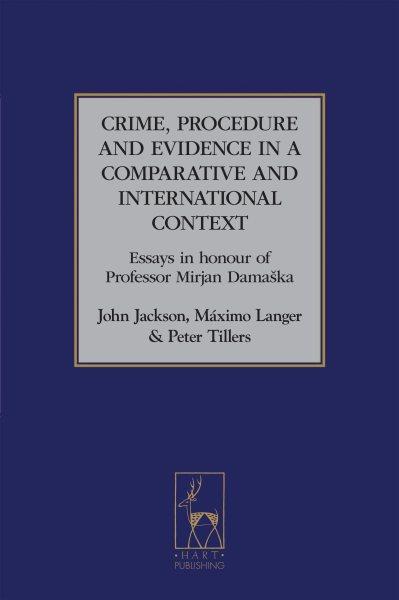
This book aims to honour the work of Professor Mirjan Damaska, Sterling Professor of Law at Yale Law School and a prominent authority for many years in the fields of comparative law, procedural law, evidence, international criminal law and Continental legal history. Professor Damaska 's work is renowned for providing new frameworks for understanding different legal traditions. To celebrate the depth and richness of his work and discuss its implications for the future, the editors have brought together an impressive range of leading scholars from different jurisdictions in the fields of comparative and international law, evidence and criminal law and procedure. Using Professor Damaska's work as a backdrop, the essays make a substantial contribution to the development of comparative law, procedure and evidence. After an introduction by the editors and a tribute by Harold Koh, Dean of Yale Law School, the book is divided into four parts. The first part considers contemporary trends in national criminal procedure, examining cross-fertilisation and the extent to which these trends are resulting in converging practices across national jurisdictions. The second part explores the epistemological environment of rules of evidence and procedure. The third part analyses human rights standards and the phenomenon of hybridisation in transnational and international criminal law. The final part of the book assesses Professor Damaska 's contribution to comparative law and the challenges faced by comparative law in the twenty first century.