The bestselling classic celebrating animation legend Walt Disney by author and photographer Christopher Finchrevised and updated to celebrate Disney 100 Years of Wonder Foreword by legendary Disney animator Floyd Norman (Sleeping Beauty, One Hundred and One Dalmatians, Mary Poppins, and The Jungle Book) Presented for the first time in a deluxe foil slipcase and real-cloth binding with foil stamping Since it was first published in 1973, The Art of Walt Disney: From Mickey Mouse to the Magic Kingdoms and Beyond has established itself as an indispensable classic of illustrated book publishing, selling hundreds of thousands of copies. Offering a comprehensive history and tribute to the career and legacy of Walt Disney, the book was the first to reveal the wealth of concept art, animation drawings, and archival material that is created in the course of animating films. Now back in print to celebrate Disney 100 Years of Wonder, this groundbreaking work collects a century of timeless animation. Autorid: Christopher Finch, Floyd Norman
"In Complaint! Sara Ahmed examines what we can learn about power from those who complain about ". Drawing on oral and written testimonies from academics and students who have made complaints about harassment, bullying and unequal working conditions at universities, Ahmed explores the gap between what is supposed to happen when complaints are made and what does happen. To make complaints within institutions is to learn how they work and for whom they work: complaint as feminist pedagogy. Ahmed explores how complaints are made behind closed doors and how doors are often closed upon those who complain. To open these doors, to get complaints through, keep them going, or keep them alive, Ahmed emphasizes, requires forming new kinds of collectives. The book offers a systematic analysis of the methods used to stop complaints and a powerful and poetic meditation on what complaints can be used to do. Following a long lineage of Black feminist and feminist of color critiques of the university, Ahmed delivers a timely consideration of how institutional change becomes possible and why it is necessary"-- In Complaint! Sara Ahmed examines what we can learn about power from those who complain about abuses of power. Drawing on oral and written testimonies from academics and students who have made complaints about harassment, bullying, and unequal working conditions at universities, Ahmed explores the gap between what is supposed to happen when complaints are made and what actually happens. To make complaints within institutions is to learn how they work and for whom they work: complaint as feminist pedagogy. Ahmed explores how complaints are made behind closed doors and how doors are often closed on those who complain. To open these doors---to get complaints through, keep them going, or keep them alive---Ahmed emphasizes, requires forming new kinds of collectives. This book offers a systematic analysis of the methods used to stop complaints and a powerful and poetic meditation on what complaints can be used to do. Following a long lineage of Black feminist and feminist of color critiques of the university, Ahmed delivers a timely consideration of how institutional change becomes possible and why it is necessary. Drawing on oral and written testimonies from academics and students who have made complaints about harassment, bullying, and unequal working conditions at universities, Sara Ahmed examines what we can learn about power from those who complain about abuses of power. Autorid: Sara Ahmed
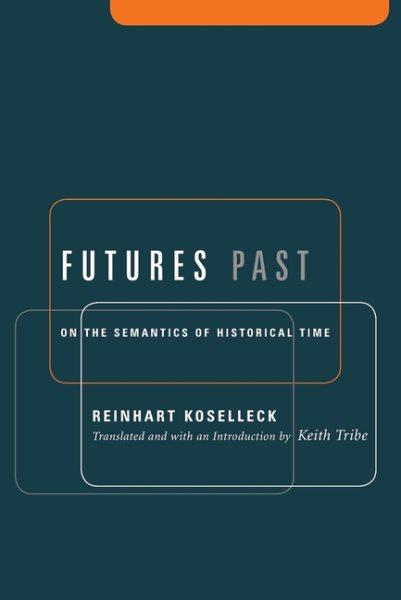
Modernity in the late eighteenth century transformed all domains of European life -intellectual, industrial, and social. Not least affected was the experience of time itself: ever-accelerating change left people with briefer intervals of time in which to gather new experiences and adapt. In this provocative and erudite book Reinhart Koselleck, a distinguished philosopher of history, explores the concept of historical time by posing the question: what kind of experience is opened up by the emergence of modernity? Relying on an extraordinary array of witnesses and texts from politicians, philosophers, theologians, and poets to Renaissance paintings and the dreams of German citizens during the Third Reich, Koselleck shows that, with the advent of modernity, the past and the future became 'relocated' in relation to each other.The promises of modernity -freedom, progress, infinite human improvement -produced a world accelerating toward an unknown and unknowable future within which awaited the possibility of achieving utopian fulfillment. History, Koselleck asserts, emerged in this crucial moment as a new temporality providing distinctly new ways of assimilating experience. In the present context of globalization and its resulting crises, the modern world once again faces a crisis in aligning the experience of past and present. To realize that each present was once an imagined future may help us once again place ourselves within a temporality organized by human thought and humane ends as much as by the contingencies of uncontrolled events. With a new, interpretive introduction by the translator, this revised edition of Koselleck's most acclaimed work is once again available in English. Koselleck explores the concept of historical time by posing the question: What kind of experience is opened up by the emergence of modernity? Koselleck explores the concept of historical time by posing the question: what kind of experience is opened up by the emergence of modernity? Autorid: Reinhart Koselleck, Keith Tribe
"An anthology of collective stories, testimonials, and incantations to guide readers through the history, legacies, and liberatory practices of healing justice"-- A profound offering and call to actioncollective stories, testimonials, and incantations for renewing political and spiritual liberation grounded in Black, Indigenous, People of Color, and Queer and Trans healing justice lineagesWe reclaim the power, resilience, and innovation of our ancestors through this book. To embody their wisdom across centuries and generations is to continue their legacy of liberation and healing. In this anthology, Black Queer Feminist editors Cara Page and Erica Woodland guide readers through the history, legacies, and liberatory practices of healing justicea political strategy of collective care and safety that intervenes on generational trauma from systemic violence and oppression. They call forth the ancestral medicines and healing practices that have sustained communities who have survived genocide and oppression, while radically imagining what comes next.Anti-capitalist, Black feminist, and abolitionist, Healing Justice Lineages is a profound and urgent call to embrace community and survivor-led care strategies as models that push beyond commodified self-care, the policing of the medical industrial complex, and the surveillance of the public health system. Centering disability, reproductive, environmental, and transformative justice and harm reduction, this collection elevates and archives an ongoing tradition of liberation and survivalone that has been largely left out of our history books, but continues to this day.In the first section, Past: Reckoning with Roots and Lineage, Page and Woodland remember and reclaim generations-long healing justice and community care work, asking critical questions like: How did our ancestors transform trauma and violence in their liberation work? What were our ancestors reckoning withand what did they imagine?The next sections, Origins of Healing Justice and Alchemy: Theory + Praxis, explore regional stories of healing justice in response to the current political and cultural landscape. The last section, Political + Spiritual Imperatives for the Future, imagines a future rooted in lessons of the past; addresses the ways healing justice is being co-opted and commodified; and uplifts emergent work thats building infrastructure for care, safety, healing, and political liberation. Autorid: Cara Page
An heiress battling amnesia must piece together which of her four suitors ultimately stole her heart in this upbeat, self-aware reverse harem romcom manga! Fans of Narumi Hasegakis other work Boss Bride Days will fall in love all over again with her swoon-worthy art style and vibrant characters. Mia Takanashi, heiress to the famed Takanashi Group, has had the world at her feet since birth. With the future of the company to think about, deciding on a marriage partner early would have its advantages. However, just as Mia set her heart on one of several charming suitors, amnesia from a freak car accident sets her back to square one! Four wildly different boys appear before her claiming to be her intended fiancé, but which of one of them did Mia ultimately choose? She may just have to fall in love all over again to find out! Autorid: Narumi Hasegaki
Original part number 2L-5206P Product name ATEN KVM Cable (HD15-SVGA, PS/2, PS/2) - 6m Producer Aten Class of product KVM cables Wire type multilead cable Plug 1 type D-SUB 15 male Plug 2 type D-SUB 15 malePS/2 malePS/2 male Colour grey-black Length 6 m
Materjal, millest Schleich figuurid on loodud: plastik ja kumm – ei ole toksilised ning ei lõhna, ei murdu kergesti ning on püsiva värviga. Kõik Schleich figuurid on käsitsi maalitud.
Võimsus: 1001–2000 W; Maksimaalne maht: 1,1 - 1,6 l; Vee temperatuuri reguleerimine: Ei; Sisselülitumise indikatsioon: Ei; Väljalülitumine keemisel: On; Sisselülitamise blokeerimine vee puudumisel: On; Kere materjal: Keraamiline; Korpuse materjal:...