Language: English, Binding: Paperback, Number of pages: 384, Publishers: Little, Brown Book Group, Author: JUSTIN MYERS, ISBN-13: 9780751583496, Date of issue: 2023
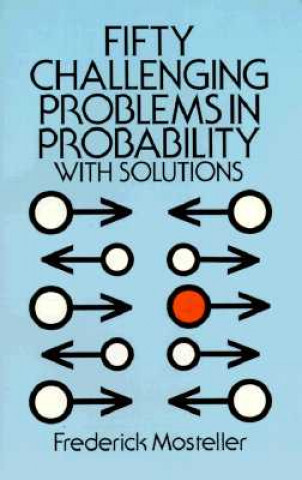
Charles Frederick Mosteller ( 1916–2006) was one of the eminent statisticians of the 20th century. He was the founding chairman of Harvard's Statistics department. Dr. Mosteller wrote more than 50 books and more than 350 papers, with over 200 coauthors. Frederick Mosteller: Harvard Man Frederick Mosteller (1916–2006) founded Harvard University's Department of Statistics and served as its first chairman from 1957 until 1969 and again for several years in the 1970s. He was the author or co-author of more than 350 scholarly papers and more than 50 books, including one of the most popular books in his field, first published in 1965 and reprinted by Dover in 1987, Fifty Challenging Problems in Probability with Solutions. Mosteller's work was wide-ranging: He used statistical analysis of written works to prove that James Madison was the author of several of the Federalist papers whose authorship was in dispute. With then–Harvard professor and later Senator Daniel P. Moynihan, he studied what would be the most effective way of helping students from impoverished families do better in school — their answer: to improve income levels rather than to simply spend on schools. Later, his analysis of the importance to learning of smaller class sizes buttressed the Clinton Administration's initiative to hire 100,000 teachers. And, as far back as the 1940s, Mosteller composed an early statistical analysis of baseball: After his team, the Boston Red Sox, lost the 1946 World Series, he demonstrated that luck plays an enhanced role in a short series, even for a strong team. In the Author's Own Words:"Though we often hear that data can speak for themselves, their voices can be soft and sly." — Frederick Mosteller
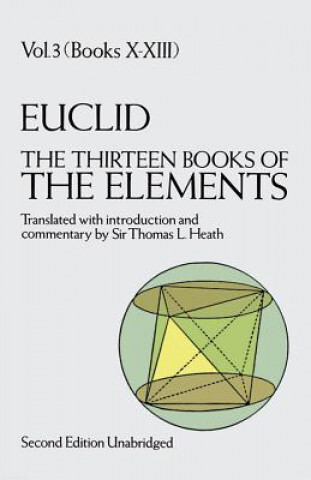
BOOK X. INTRODUCTORY NOTE DEFINITIONS I. PROPOSITIONS I?47 DEFINITIONS II. PROPOSITIONS 48?84 DEFINITIONS III. PROPOSITIONS 85?115 ANCIENT EXTENSIONS OF THEORY OF BOOK XBOOK XI. DEFINITIONS PROPOSITIONSBOOK XII. HISTORICAL NOTE PROPOSITIONSBOOK XIII. HISTORICAL NOTE PROPOSITIONS"APPENDIX. I. THE SO-CALLED "BOOK XIV." (BY HYPSICLES)"II. "NOTE ON THE SO-CALLED "BOOK XV."GENERAL INDEX : GREEK" " " ENGLISH"
Separated from his wife Irene for some years now, Soames Forsyte has resigned himself to the fact she's never coming back. But as he grows older and richer, he yearns for an heir. When he confronts Irene, the raw wounds of his past passion are exposed and he will do anything to claim back what is his. Then his cousin Jolyon Forsyte moves in to protect and champion Irene and the old rift in the family splinters into new jealousy, hatred and fear. But this time it runs too deeply for forgiveness...
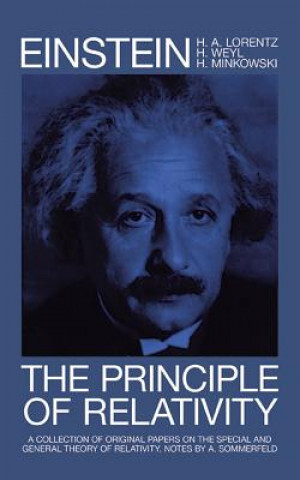
In addition to conducting the research that culminated in his acclaimed theories of relativity, Albert Einstein (1879-1955) taught and lectured at universities around the world. Einstein received numerous awards and honorary doctorate degrees in science, medicine, and philosophy, and he remains a towering symbol of intellectual and imaginative achievement. It's All Relative Around 1950, Hayward Cirker, Founder and President of Dover Publications, wrote to Einstein and asked his approval to proceed with a Dover paperback reprint of the 1923 collection of original papers on relativity by Einstein himself and others (H. A. Lorentz, H. Weyl, and H. Minkowski), which had originally been published in England. Einstein was reluctant, wondering how much interest there could possibly be in this relic of his work from 30 or more years earlier. Cirker persisted, and Einstein finally agreed — the Dover edition of The Theory of Relativity has been in print ever since and has been followed by many other Dover books on relativity. The papers reprinted in this original collection will always be for the serious student the cornerstone of their Einstein library: Michelson's Interference Experiment (H. A. Lorentz); Electromagnetic Phenomena in a System Moving with any Velocity Less Than That of Light (H.A. Lorentz); On the Electrodynamics of Moving Bodies (A. Einstein); Does the Inertia of a Body Depend Upon its Energy Content? (A. Einstein); Space and Time (H. Minkowksi with notes by A. Sommerfeld); On the Influence of Gravitation on the Propagation of Light (A. Einstein); and The Foundation of the General Theory of Relativity (A. Einstein) found on pages 109–164 of this text; Hamilton's Principle and The General Theory of Relativity (A. Einstein); Cosmological Considerations on the General Theory of Relativity (A. Einstein); Do Gravitational Fields Play an Essential Part in the Structure of the Elementary Particles of Matter? (A. Einstein); and Gravitation and Electricity (H. Weyl). In the Author's Own Words: "How can it be that mathematics, being after all a product of human thought independent of experience, is so admirably adapted to the objects of reality?" "What nature demands from us is not a quantum theory or a wave theory; rather, nature demands from us a synthesis of these two views which thus far has exceeded the mental powers of physicists." "Do not be troubled by your difficulties with Mathematics, I can assure you mine are much greater." — Albert Einstein Critical Acclaim for The Theory of Relativity: "This book constitutes an indispensable part of a library on relativity." — Nature
Floss's parents are divorced, and she divides up her week, spending five days with her mum, her new stepdad and her baby half-brother. The other two days Floss spends with her dad, helping him to run his greasy spoon cafe. But their simple arrangement is thrown into disarray when Floss's mum decides to move to Australia. Making the difficult decision to stay at home, Floss moves in permanently with her dad and they muddle along happily together, surviving on chip butties and enjoying visits to the local funfair. But disaster strikes - Dad's money troubles catch up with him and they have to move out of the cafe. They're homeless - but can their new fairground friends help out?
"Il semblait que la colonisation n'avait été rien d'autre qu'un malentendu, une erreur dont les Français à présent se repentaient et que les Marocains faisaient semblant d'oublier." Maroc, 1968 : tandis que Mathilde s'occupait du foyer, Amine est parvenu à faire de son domaine aride une entreprise florissante. Ils appartiennent désormais à une bourgeoisie qui prospère, fait la fête et croit en des lendemains heureux. Mais le retour de leur fille Aïcha, partie étudier en France, fait voler en éclats le glacis d'apparence qui figeait cette famille. Le modèle d'émancipation qu'ils croyaient incarner depuis l'indépendance n'est-il qu'une illusion ? Après Le pays des autres, Regardez-nous danser poursuit une fresque familiale vibrante d'émotions et de personnages inoubliables.
A gripping ghost story from Britains best-loved children's storyteller, full of friendship, adventure and a pirate queen. 'Youre not . . . youre not Grania OMalley, are you?' 'Who else would I be?' she said. Everyone knows the Big Hill is full of gold, and now the islanders are intent on cutting the top off it and making themselves rich. Jessie and Jake are determined to save the Big Hill but what can they do? A plan is needed, and fast. Could the ghost of Grania O'Malley, the pirate queen, be the answer? You don't know what you can do until you try. Michael Morpurgo has written more than one hundred books for children and won the Whitbread Award, the Smarties Award, the Circle of Gold Award, the Childrens Book Award and has been shortlisted for the Carnegie Medal four times.