Spinning Tail Teaser paneb sind keerlema mitmel erineval viisil. Avastage 7 vibreerimis- ja pöörlemiskiirust ning rütmi käed-vabad, tänu sellele elegantselt lihtsale kaugjuhitavale anaaltapile. Kogege klassikalist täiskõhutunnet selle täiusliku kaalu ja kujuga. Valmistatud sametiselt siledast silikoonist, pistiku tekstuuritud pind suurendab aistinguid, samal ajal kui see keerleb ja vibreerib. Naudi mänguvabadust!- Mängi minuga (põhifunktsioon): Keerlev, tekstuuritud vibreeriv anaaltapp- Kaugjuhtimise ulatus: 25 jalga / 7,6 meetrit- Vibratsioon: 7 vibreerimis- ja pöörlemiskiirust ning rütmi- Materjal: Kehasõbralik silikoon- Ftalaadi- ja lateksivaba- Veekindel ja sukeldatav- Laetav: USB-kaabel kaasas- Kõrgus: 3,83 tolli / 9,7 cm- Sügavus: 1,76 tolli / 4,5 cm- Laius: 1,38 tolli / 3,5 cm
This series provides an ideal platform to study chess openings. By continually challenging the reader to answer probing questions throughout the book, the Move by Move format greatly encourages the learning and practising of vital skills just as much as the traditional assimilation of opening knowledge. Carefully selected questions and answers are designed to keep you actively involved and allow you to monitor your progress as you learn. This is an excellent way to study any chess opening and at the same time improve your general chess skills and knowledge. In this book, International Master Cyrus Lakdawala invites you to join him in studying the Alekhine Defence. Black's idea in the Alekhine Defence is a bold one. By inviting White's central pawns to advance, Black hopes later on to undermine and demolish White's centre. This ambitious strategy appeals to players who enjoy sharp lines and positional imbalances.Using illustrative games, Lakdawala outlines a reliable repertoire for Black, examines the main positional and tactical ideas for both sides, provides answers to all the key questions and tells you everything you need to know about successfully playing the Alekhine Defence. *Essential guidance and training in the Alekhine Defence *Presents a repertoire for Black with 1 e4 Nf6 *Utilizes an ideal approach to chess study
Your hard work is paying off. You are doing well in your field. But there is something standing between you and the next level of achievement. That something may just be one of your own annoying habits. Perhaps one small flaw - a behaviour you barely even recognise - is the only thing that's keeping you from where you want to be. It may be that the very characteristic that you believe got you where you are - like the drive to win at all costs - is what's holding you back.As this book explains, people often do well in spite of certain habits rather than because of them - and need a "to stop" list rather than one listing what "to do". Marshall Goldsmith's expertise is in helping global leaders overcome their unconscious annoying habits and become more successful. His one-on-one coaching comes with a six-figure price tag - but in this book you get his great advice for much less.Recently named as one of the world's five most-respected executive coaches by Forbes, he has worked with over 100 major CEOs and their management teams at the world's top businesses. His clients include corporations such as Goldman Sachs, Glaxo SmithKline, Johnson and Johnson and GE.
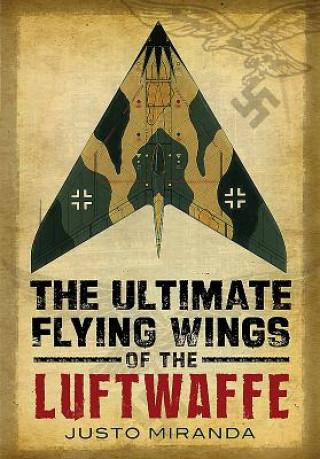
Key Selling Points:*An extra-ordinary books which chronicles for the first time the outlandish designs that the Germans were working on in 1945*Presents a historical framework and performance details for each model*Profusely illustrated with technical drawings and gives exhaustive coverage of different models and variants*Technical data and measures for modellers*Written by the best-selling author of "Ultimate Piston Fighters of the Luftwaffe" ISBN: 9781781552490It might have happened. With the Allied forces pushing into Germany, a desperate Hitler launched the next breed of German aircraft. Imagine a strange triangular bomber, that could not be detected by radar or intercepted by fighters, launching an inextinguishable ball of fire over London which destroys the city and its surroundings up to the sea. Or perhaps a black boomerang sixty meters long drops two tons of anthrax over Washington and New York, making them uninhabitable for fifty years. Or perhaps a scenario where an allied bombing raid experiences massive casualties, savaged by an armada of new German fighters, the like of which the Allied gunners had never seen before.They are dart shaped, too fast for the gunners to take aim, so the new Nazi flying wings and triangles decimate the bombers with their cannon fire and missiles that were automatically activated by photo-electric cells. These things never occured. However, the construction of secret flying wings had commenced at the start of 1945 and one extraordinary new fighter took to the skies on its only test flight. If these radical fighters of the Luftwaffe had been pressed into service earlier, they may well have changed the outcome of the Second World War. Profusely illustrated with technical drawings and fascinating data and information on the Luftwaffe's most radical fighter and bomber projects, The Ultimate Flying Wings of the Luftwaffe chronicles these revolutionary designs. A fascinating book for the military historian, enthusiastic modelers and those interested in the more extreme side of World War 2 aviation, this book shows how advanced German scientists were towards the end of the Second World War and how close Hitler may have come in winning after all.
Seeing, hearing, smelling, tasting, touching -- our bodies do all kinds of amazing things In this delightful and educational picture book, author Pamela Hill Nettlet, along with illustrator Becky Shipe, give children an exciting, colorful introduction to
On 30 November 1939, Soviet bombers unloaded their bombs on Helsinki, the capital of Finland. Stalin's ultimatum, demanding the cession of huge tracts of territory as a buffer zone against Nazi Germany, had been rejected by the Finnish government, and now a small Baltic republic was at war with the giant Soviet military machine. But this forgotten war, fought under brutal, sub-arctic conditions, often with great heroism on both sides, proved one of the most astonishing in military history. Using guerrilla fighters on skis, even reindeer to haul supplies on sleds, heroic single-handed attacks on tanks, and with unfathomable endurance and the charismatic leadership of one of the 20th century's true military geniuses, Finland not only kept at bay but won an epic, if short-lived, victory over the hapless Russian conscripts. Its surreal engagements included the legendary "Sausage Battle", when starving Soviet troops who had over-run a Finnish encampment couldn't resist the cauldrons of hot sausage soup left behind by their opponents - and were ambushed as they stopped to sup.Although by sheer attritional weight of numbers Stalin eventually prevailed over the Finns, their pointed resistance enabled their country to remain free, even as other countries fell one by one.
Curses have given the world some of its greatest legends and folklore, and the more grisly and gory, the better we like them. But cursing, or ill-wishing, is not a practice confined to magical practitioners - black, white or grey - it is a form of expression intended to do harm in reparation for some real or imagined insult and can be 'thrown' by anyone of any race, culture or creed without any prior experience of ritual magic or witchcraft. According to the dictionary, however, a curse is defined as: to invoke or wish evil upon; to afflict; to damn; to excommunicate; evil invoked on another person. If this is the clear definition, then under what circumstances can we challenge this established way of thinking and ask ourselves can cursing ever be justified? And if we hesitate for just a moment, then we must ask the next question: Is cursing evil? Like all aspects of life, however, it is advisable to put things in their proper perspective before passing judgement. Worldwide.
Many similarities exist between the new movements against austerity that have emerged since 2011, ranging from Taksim Square in Turkey to the Chilean student protests, and from Greece to NYC. One of them is their return to the principles of direct democracy and their organization around popular assemblies. These ideas are hardly new - Murray Bookchin, who is one of the leading anarchist thinkers of the twentieth century, has been elaborating ideas about popular assemblies for several decades that have influenced thinkers such as David Harvey. "The Next Revolution" brings together Bookchin's writings on popular assemblies for the first time, just as his ideas are rekindling the radical imagination worldwide.
"Latin to GCSE" is a complete course in two volumes, of which this is Part 2. The course covers all the ground necessary for those studying for a GCSE in Latin. The authors concentrate on imparting an understanding the principles of grammar (both accidence and syntax) without getting bogged down in minor irregularities. Like its companion course, "Greek to GCSE," the books include a good range of reading passages and the background material necessary to their understanding. Revision material is included at the end of Part 2.