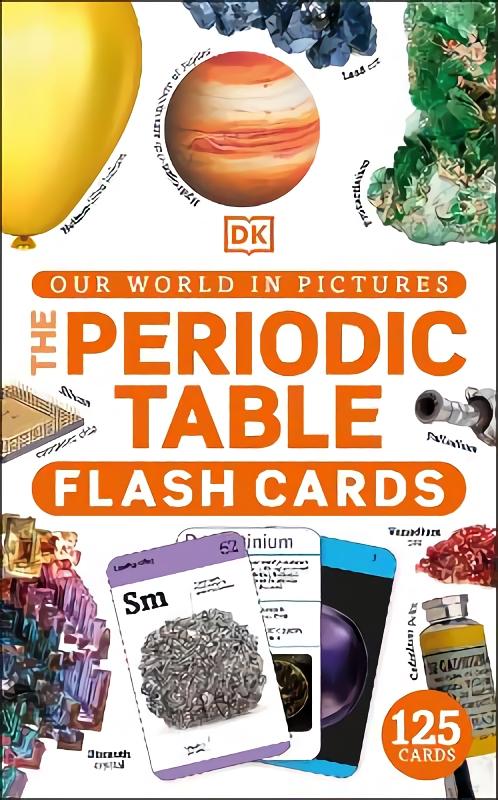
Get to grips with the periodic table through an array of guessing games and fun flashcards! This amazing deck of cards welcomes you to the periodic table of elements where you can familiarise yourself with all 118 elements, discovering atomic numbers, mass, melting points and more. The fast facts and intriguing pictures will allow you to grasp a wealth of knowledge in a fun and engaging way! Celebrate your child's curiosity as they explore: -One card for each of the 118 elements -The element's chemical symbol and image are on the front, with a data-set including the element's atomic number, -atomic mass, period, melting point, and when it was discovered are on the back. -Includes supporting information on the periodic table and how atoms and elements work. -A glossary contains definitions of the most relevant terms to do with the periodic table. -Visual aids, such as photos of the elements in their raw state or in use, promote faster learning. -Cards are two-sided, laminated, and packed in a durable cardboard carton. Each card contains snappy and accessible information, displaying an eye-catching image of each chemical element, whilst show-casing the element's uses and how it appears in nature. You can use the cards to test your own knowledge, or how about using them to play a guessing game, quiz, or even a competitive comparison game with a friend? The brightly coloured cards make learning easy and fun for students and chemistry enthusiasts alike. A must-have volume for young readers aged 9+ who love science and are seeking a fun and engaging exploration of the periodic table of elements. Our World in Pictures: The Periodic Table Flashcards breaks down information on each one of the 118 total elements into manageable chunks of memorable and fascinating facts that can keep the kids enthralled for hours on end! A jaw-dropping spectrum of atom types- from lithium to magnesium and more - this all-encompassing chemistry book for kids provides a learning experience like no other! At DK, we believe in the power of discovery. So why not complete the collection? Our World in Pictures is back with an all-encompassing animal book for kids. Explore the animal kingdom like never before with Our World In Pictures: Animals of the World Flashcards and test your new-found knowledge with friends and family.
As she struggles to find her feet with her work, new problems emerge Meg Turner is finally doing the job she loves, but life as a sheep farmer proves tougher than she anticipated. She is a woman trying to prove herself in a man's world against the backdrop of a brutal war. With her faith being tested in her work, she also fears that the man she loves will betray her again. Meg struggles to allow herself to love baby Lissa when her mother may return to claim her at any moment. Meanwhile, Kath faces new challenges in the WAAF, but cannot stop thinking about her child. Can she ever get over the guilt of leaving her child behind? A heartwarming story of love and loyalty, perfect for fans of Anna Jacobs and Rosie Harris. Autorid: Freda Lightfoot
There are some of us who cant even stand to look at themand others who cant live without them: chillies have been searing tongues and watering eyes for centuries in innumerable global cuisines. In this book, Heather Arndt Anderson explores the many ways nature has attempted to take the roofs of our mouths offfrom the deceptively vegetal-looking jalapeno to the fire-red ghost pepperand the many ways we have gleefully risen to the challenge. Arndt Anderson tells the story of the spicy berrys rise to prominence, showing that it was cultivated and venerated by the ancient people of Mesoamerica for millennia before intrepid Spanish explorers brought them back to Europe. She traces the chillis spread along trading routes to every corner of the globe, and she explores the many important spiritual and cultural links that we have formed with them, from their use as an aphrodisiac to, in more modern times, an especially masochistic kind of eating competition. Ultimately, she uses the chili to tell a larger story of global trade, showing how the spread of spicy cuisine can tell us much about the global exchangeand sometimes dominationof culture. Mixing history, botany, and cooking, this entertaining read will give your bookshelf just the kick it needs. Autorid: Heather Arndt Anderson
Religious commitments can be a powerful engine for progressive social change, and in this new book, Raúl E. Zegarra examines the process of articulation of religious beliefs and political concerns that takes place in religious organizing and activism. Focusing on the example of Latin American liberation theology and the work of Peruvian theologian Gustavo Gutiérrez, Zegarra shows how liberation theology advocates have been able to produce a new balance between faith and politics that advances an agenda of progressive social change without reducing politics to faith or faith to politics. Drawing from theologian David Tracy's method of critical correlation, the book focuses on key historical, philosophical, and theological shifts that have allowed liberation theologians to produce a new interpretation of the relationship between faith and politics in the Christian tradition, especially when issues of social justice are at stake. The book further approaches liberation theology's contributions to theorizing social justice through an unconventional path: a critical dialogue with the work of philosopher John Rawls. This dialogue, as Zegarra contends, allows us to see more clearly the contributions of liberation theology to the cause of progressive social change. Ultimately the book stands between "public religion" and "public reason," offering something of a blueprint for theological innovation and for how to remain committed to one's faith while respecting and defending the core values of democracy. Autorid: Raúl E. Zegarra
A cuddly soft cloth book for babies! Babies are introduced to 11 colors in this large and snuggly cloth book with 8 different textures perfect for early tactile learning and developing fine motor skills. Bright, eye-catching illustrations of cute animals feature the primary colors, as well as secondary ones like gray, pink, and orange. Bold, cheerful illustrations help engage the youngest readers Colors concept is essential in early-learning programs Plush and cloth book are made of soft non-toxic and machine-washable fabric Perfect baby shower giftFans of this book will also enjoy another Baby Basics title, My Cuddly Fox. Fun family read-aloud book Books for children aged 0-3 Books for babies Autorid: Marion Billet
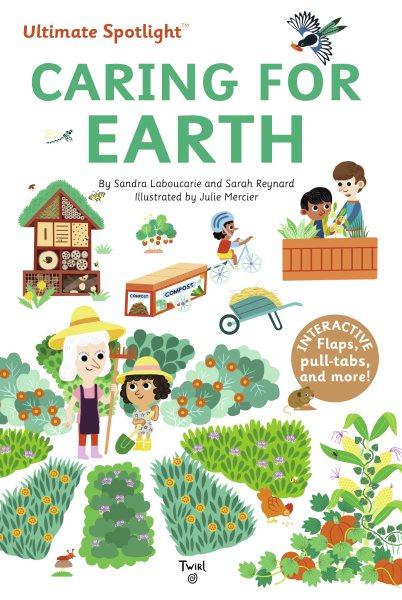
A kid-friendly primer on caring for the Earth and living in harmony with nature. Inspired by the natural world, Ultimate Spotlight: Caring for Earth shows children how creating an environment that resembles the way plants and animals interact in the wild benefits everyone. Turn a page to reveal a pop-up of a multi-layered orchard, lift a flap to see how compost is made, and rotate a wheel to observe a trees transformation as the seasons change. Flaps! Pull-tabs! Pop-ups! Lots of interactive and moveable parts Detailed illustrations that beg to be pored over again and again Educational content reviewed by expertsFans of Ultimate Spotlight Caring for Earth will also enjoy the interactive learning of other books in the Ultimate Spotlight series, including Extraordinary Animals, Volcanoes, Polar Animals, Rain Forest Animals, Savanna Animals, Dinosaurs, Firefighters, Trains, and Astronauts. Great family and classroom read-aloud book Books for 5 and up Books for kindergarten and early elementary school students Autorid: Sandra Laboucarie, Sarah Reynard, Julie Mercier
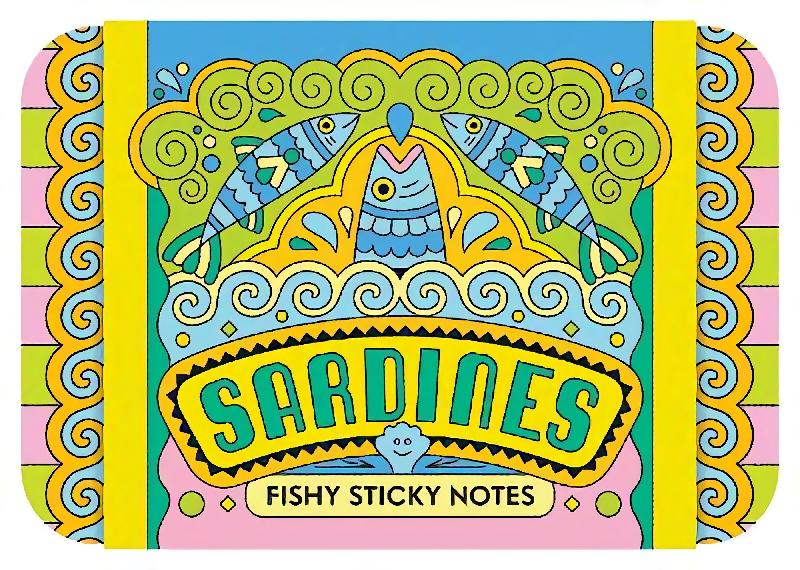
Something delightfully fishy to write on! This trio of sticky notepads in a realistic sardine tin is the catch of the day for home or office fun. Fishing for a little something to write on or a great gift for a tinned food enthusiast? Try these fin-tastic sardine sticky notesthey look good enough to eat but are made for jotting down all those important thoughts. Three die-cut notepads with 180 pages each are tucked into a cool retro-design tin with a sliding lid. Once the notes are done, the tin makes a terrific keepsakethe perfect catch for bits and bobs. Autorid: Chronicle Books, Nolan Pelletier
Only when we fully appreciate the origins and foundations of child and adolescent behaviors will we succeed in uncovering why they do what they do. By emphasizing evolutionary viewpoints of human psychological development, this textbook explains the fundamental underpinnings of young minds and how they grow. New chapters on the biological basis and cultural context of development introduce students to dynamic new debates in the field. The integrative, topical approach incorporates the perspectives that guide today's practitioners and gives students a holistic and up-to-date understanding of development. Box features highlight key debates, Section Reviews reinforce essential points, and Ask Yourself questions and end-of-chapter exercises encourage engagement and extend learning, supporting and enhancing student understanding. Revised and updated throughout, this comprehensive, topical textbook uniquely integrates the central themes of modern developmental theory developmental contextualism, sociocultural perspective, and evolutionary theory in a strong, theoretical introduction to child and adolescent development. Autorid: David F. Bjorklund, Carlos Hernández Blasi
An incisive and deeply candid account that explores autistic women in culture, myth, and society through the prism of the author's own diagnosis. Until the 1980s, autism was regarded as a condition found mostly in boys. Even in our time, autistic girls and women have largely remained invisible. When portrayed in popular culture, women on the spectrum often appear simply as copies of their male counterparts -- talented and socially awkward. Yet autistic women exist, and always have. They are varied in their interests and in their experiences. Autism may be relatively new as a term and a diagnosis, but not as a way of being and functioning in the world. It has always been part of the human condition. So who are these women, and what does it mean to see the world through their eyes? In The Autists, Clara Tornvall reclaims the language to describe autism and explores the autistic experience in arts and culture throughout history. From popular culture, films, and photography to literature, opera, and ballet, she dares to ask what it might mean to re-read these works through an autistic lens -- what we might discover if we allow perspectives beyond the neurotypical to take centre stage.
The Commodore 64 is the most signifi cant computer of its era. From 1982 to 1994, a total of 27 million units were sold-more than any other computer from a single manufacturer a erwards. Due to its widespread use as well as its technicalfeatures, the C64 has a huge international following-even to this day. The 19 contributions compiled in this book illustrate the signifi cance of the platform for the digitalization of society, the general public's computer science knowledge,as well as digital art and culture-both in the past, present, and also in the future. Volume 5 of the 'Computer Archaeology' series is partly based on the conference of the same name held in 2024 at the University of Bonn and has here beensupplemented with additional contributions from the fi elds of artifi cial intelligence, quantum computing, and digital humanities.
In clear, accessible and engaging style Thought: The Basics gets to grips with the nature of human thought with just the right balance of theory and examples from philosophy, psychology and neuroscience. Ideal for anyone coming to this fascinating but deceptively difficult topic for the first time. Our heads buzz with them while we're awake. They can spur us to action and creativity, or to daydream, and can be opinionated or contemplative, fleeting or recurring. Without them we may appear robotic and lifeless. Yet it remains surprisingly difficult to explain even the rudiments of thought without confusion or philosophical controversy.In clear, accessible and engaging style Thought: The Basics gets to grips with the nature of human thought, addressing important questions such as:What are the contents of thought?How does thought represent the world around us?Is thought possible without language?What causes thoughts in the first place?Can one be impartial about one's thoughts, or is though subject to bias?What is rational thought?Is a body required for thought?What is free thought?With just the right balance of theory and examples from philosophy, psychology and neuroscience, Thought: The Basics is ideal for anyone coming to this fascinating but deceptively difficult topic for the first time. Autorid: Léa Salje