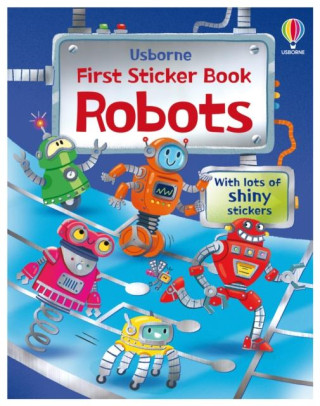
Welcome to Robot City! Join the inhabitants of this bustling mechanical metropolis as they go about their days. See robots soaring through the sky with their booster jets, building a rocket from recycled scrap, and have a go building and customizing your own robot. With over 100 stickers to keep kids entertained for hours. <br><br> Autorid: Alice Beecham, Valeria Danilova <br>
GTIN: 9781835409510For National Curriculum Early Years (England & Wales)
Welcome to Robot City! Join the inhabitants of this bustling mechanical metropolis as they go about their days. See robots soaring through the sky with their booster jets, building a rocket from recycled scrap, and have a go building and customizing your own robot. With over 100 stickers to keep kids entertained for hours.
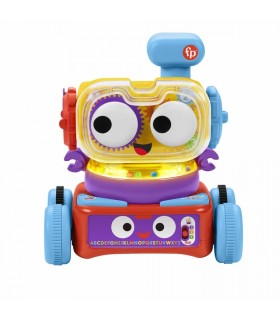
<p>Fisher-Price® eestikeelne õpirobot on arendav mängukaaslane. Robotil on 4 erinevat mänguvõimalust koos lõbusa muusika, valgusefektide ja praktiliste tegevustega. Robot käib kokku mitmest erinevast osast, mille iga osaga saab laps eraldi mängida. Beebi saab robotiga suhelda, uudistada iga roboti osa eraldi või ehitada neist ühe suure interaktiivse sõbra, kes rõõmustab beebit muusika, helide ja eesti keelsete fraasidega! </p><p>Õpirobot motiveerib last roomama ja liikuma. Smart Stages® tehnoloogia abil saate muuta õppesisu vastavalt lapse vanusele ja arengutasemele. </p><div>Toote omadused:</div><ul><li>4 mänguasja ühes: peale pea eemaldamist vajuta üleval olevat nuppu, et liigutada roboti silmi, avada ja vaadata, mis kõrvade taga peidus on. Keskmiselt astmelt leiab lõbusa mängu pallidega, kolmas tasand julgustab last erinevates värvides roomama.</li><li>Põrandal liikudes julgustab robot last taga ajama ja roomama.</li><li>Õpetab numbreid ja loendamist, tähestikku, värve ja kujundeid.</li><li>3 koolitustaset.</li><li>Rohkem kui 120 meloodiat, laulu, fraasi.</li><li>Sellel on keelevaliku funktsioon.</li><li>Vajab 4 x R14 patareid.</li></ul><iframe width="560" height="315" src="https://www.youtube.com/embed/Ba_ieSc7wHU" title="Eestikeelne Fisher-Price® õpirobot" frameborder="0" allow="accelerometer; autoplay; clipboard-write; encrypted-media; gyroscope; picture-in-picture; web-share" allowfullscreen="allowfullscreen"></iframe>
<p>Fisher-Price® eestikeelne õpirobot on arendav mängukaaslane. Robotil on 4 erinevat mänguvõimalust koos lõbusa muusika, valgusefektide ja praktiliste tegevustega. Robot käib kokku mitmest erinevast osast, mille iga osaga saab laps eraldi mängida. Beebi saab robotiga suhelda, uudistada iga roboti osa eraldi või ehitada neist ühe suure interaktiivse sõbra, kes rõõmustab beebit muusika, helide ja eesti keelsete fraasidega! </p><p>Õpirobot motiveerib last roomama ja liikuma. Smart Stages® tehnoloogia abil saate muuta õppesisu vastavalt lapse vanusele ja arengutasemele. </p><div>Toote omadused:</div><ul><li>4 mänguasja ühes: peale pea eemaldamist vajuta üleval olevat nuppu, et liigutada roboti silmi, avada ja vaadata, mis kõrvade taga peidus on. Keskmiselt astmelt leiab lõbusa mängu pallidega, kolmas tasand julgustab last erinevates värvides roomama.</li><li>Põrandal liikudes julgustab robot last taga ajama ja roomama.</li><li>Õpetab numbreid ja loendamist, tähestikku, värve ja kujundeid.</li><li>3 koolitustaset.</li><li>Rohkem kui 120 meloodiat, laulu, fraasi.</li><li>Sellel on keelevaliku funktsioon.</li><li>Vajab 4 x R14 patareid.</li></ul><iframe width="560" height="315" src="https://www.youtube.com/embed/Ba_ieSc7wHU" title="Eestikeelne Fisher-Price® õpirobot" frameborder="0" allow="accelerometer; autoplay; clipboard-write; encrypted-media; gyroscope; picture-in-picture; web-share" allowfullscreen="allowfullscreen"></iframe>
<p>Fisher-Price® eestikeelne õpperobot on arendav mängukaaslane. Robotil on 4 erinevat mänguvõimalust koos lõbusa muusika, valgusefektide ja praktiliste tegevustega. Robot käib kokku mitmest erinevast osast, mille iga osaga saab laps eraldi mängida. Beebi saab robotiga suhelda, uudistada iga roboti osa eraldi või ehitada neist ühe suure interaktiivse sõbra, kes rõõmustab beebit muusika, helide ja eestikeelsete fraasidega! Robot pakub hulgaliselt avastamisrõõmu oma pöörlevate silmade, liikuva juhtkangi ja õõtsumisega.</p> <p>Mänguasi motiveerib last roomama ja liikuma. Smart Stages® tehnoloogia abil saate muuta õppesisu vastavalt lapse vanusele ja arengutasemele.</p> <p>Mängimiseks alates 6. elukuust</p> <p>Toote mõõdud on 24 x 28 x 18 cm</p> <p>Toode töötab 4 x C patareidega, mis on komplektis kaasas.</p> <p>Robot oskab rääkida eesti, vene, inglise, läti, leedu ja ukraina keeles. </p>
Every morning, FIXER robot, trundles up the hill To help the other robots as they dig and push and drill. A charming text that combines a truly heart-wrenching story with mechanical details, sure to enchant every young engineer. <br><br> Autorid: John Kelly <br>
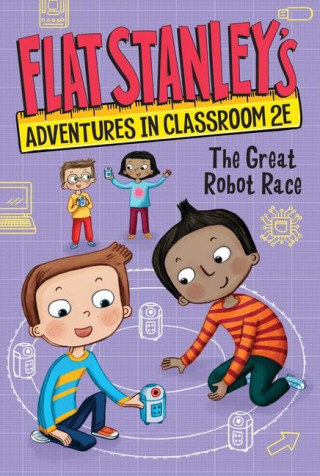
Beloved character Flat Stanley is back with a whole new set of friends in this STEM-focused chapter book series. In the fourth book, Stanley and his best friend, Marco, learn all about coding and friendship during Classroom 2Es great robot race!Ever since Stanley Lambchop was flattened by a bulletin board, each day brings new adventures!Stanley likes to follow the rules, but he can get carried away sometimes when listening to his best friend, Marco. And the last thing Stanley wants to do is get in troubleagain.When Ms. Root introduces Classroom 2E to movable robots called Zoombots, Stanley tries to follow her coding directions exactly. But when Marco just wants to have the fastest robot in class, trouble may be ahead! Can Stanley and Marco win a robot race while following the rules, and will Stanley learn to speak up for himself?Featuring adorable black white illustrations, an accessible approach to STEM topics, and additional coding resources. Dont miss any of Flat Stanleys classroom adventures!Robots for Kids: Meet the Zoombots! Stanley and Marco get to program their own robot, Zack, for a classroom competition.Friendship Story: Marcos big ideas are fun, but sometimes theyre bad ideas. When winning the race is all that matters, Stanley has to decide what being a good friend really means.Learning to Speak Up: Stanley is a rule-follower, but its hard to say no to his best friend. This time, hell have to find his voice to do the right thing.STEM Chapter Book: An exciting, hands-on introduction to coding concepts that makes learning fun. Includes a bonus list of real coding resources for kids!
Flip the pages and build your very own incredible robots, with different choices on every page and over 180 different robots to make! Bo and Mo need to tidy their bedroom . . . and they are going to build a robot to help!This fun-filled flip-the-page book has more than 180 different robots to build: will your robot play football, cook your tea, talk to you, or hop around on springs? And what happens when the wiring goes wrong !This entertaining series introduces preschoolers to S.T.E.A.M concepts through storytelling and play, and fans of Playmobil, Lego and Duplo will love creating their very own robots again and again.Packed full of facts, plus plenty of hand-on interactive fun, Flip Flap Build: Rockets is perfect for supporting early S.T.E.A.M learning. Tips at the back of the book help parents and carers to support learning at home, and the bright, bold and stylish illustrations from bestselling illustrator Ben Newman (Stemville, Professor Astro Cat) are packed with incredible details.And if you like this book, why not check out Flip, Flap, Build: Rockets and build your way to an outer space adventure! <br><br> Autorid: Macmillan Children's Books, Ben Newman <br>
From cell to robot: A bio-inspired locomotion device
Tootekood: A26184943GTIN: 9783838151564Matemaatika ja teadus
Bionics or biomimetics is an interdisciplinary scientific approach to apply naturally developed biological systems, methods and solutions to the study and design of technology as an exclusive mutuality between life sciences and technology sciences, such as robotics. Robots are artificial agents which have much in common with biological agents in case of the need to adapt to their environment. Soft robots have a rather flexible skin or shape, propulsing itself with some type of crawling movement and are able to deform and adapt to obstacle, which is advantageous over classical wheeled or legged propulsion. Most of bio-inspired climbing robots have the disadvantage of using legs for locomotion. The idea is to find a new biological model for a bi-inspired robotic locomotion device. Surprisingly, single cells, such as amoebae or animal tissue cells have a deformable shape and the ability to crawl on surfaces by adhesion. A perfect model for a new bio-inspired locomotion device. This book demonstrates that it is possible to transfer the biophysical locomotion mechanism of cell migration to a computational simulation model of a soft robot with a crawling cell like locomotion.
Tootekood: A40031335GTIN: 9783030349769Viited, teave ja interdistsiplinaarsed teemad
This book presents a unified mathematical treatment of diverse problems in the general domain of robotics and associated fields using Clifford or geometric alge- bra. By addressing a wide spectrum of problems in a common language, it offers both fresh insights and new solutions that are useful to scientists and engineers working in areas related with robotics. It introduces non-specialists to Clifford and geometric algebra, and provides ex- amples to help readers learn how to compute using geometric entities and geomet- ric formulations. It also includes an in-depth study of applications of Lie group theory, Lie algebra, spinors and versors and the algebra of incidence using the universal geometric algebra generated by reciprocal null cones. Featuring a detailed study of kinematics, differential kinematics and dynamics using geometric algebra, the book also develops Euler Lagrangeand Hamiltoni- ans equations for dynamics using conformal geometric algebra, and the recursive Newton-Euler using screw theory in the motor algebra framework. Further, it comprehensively explores robot modeling and nonlinear controllers, and discusses several applications in computer vision, graphics, neurocomputing, quantum com- puting, robotics and control engineering using the geometric algebra framework. The book also includes over 200 exercises and tips for the development of future computer software packages for extensive calculations in geometric algebra, and a entire section focusing on how to write the subroutines in C++, Matlab and Maple to carry out efficient geometric computations in the geometric algebra framework. Lastly, it shows how program code can be optimized for real-time computations. An essential resource for applied physicists, computer scientists, AI researchers, roboticists and mechanical and electrical engineers, the book clarifies and demon- strates the importance of geometric computing for building autonomous systems to advance cognitive systems research.
Since Papi was deported, Mimi Perez hustles around her Brooklyn neighborhood fixing things to earn money and joins a robotics competition to win a $50,000 prize, and when a robot crashes to earth from space, Mimi brings it home to fix. Simultaneous eBook. An out-of-this-world story about friendship, empowerment, and . . . running from federal agents?E.T. meets cult classic The Iron Giant in this middle grade light sci-fi from Emmy Award-winner Oz Rodriguez and New York Times best-selling author Claribel A. Ortega, perfect for fans of Witchlings.With a little heart, you can fix anything.Mimi Perez fixes things. Phones, tablets, speakers, printers. She gets it from her dadhelping him at the family e-repair shop was always one of Mimis favorite things to do. But ever since Papi was deported, theres a lot more than electronics that need fixing in Mimis world. Things too big for any twelve-year-old to handle on her own.Mimi hustles around her Brooklyn neighborhood trying to earn enough money to finally fix her family. Theres no time for school or friends, but Mimi knows it will all be worth it the day Papi comes home. Then her ex-friends approach her with a proposition: enter a robotics competition with them, and they could win $50,000. It could be her chance.Not part of the plan? A mysterious robot crashing to earth. From space.The robot is scared, alone, and broken, and federal agents are after her. Mimi does what any street-smart electronics repair person would do: she takes the robot home, fixes her up, and in the process, makes herself a friend.Suddenly, Mimi is anything but alone. Shes part of a robotics team. Shes sheltering a robot. Shes dodging federal agents. And keeping all of it a secret from her mom.Join a girl and a robot on their life-changing sci-fi adventure in this coming-of-age story that celebrates kids in STEM, first-gen communities, and the power of friendship. <br><br> Autorid: Oz Rodriguez, Claribel A. Ortega <br>
"A mysterious package arrives with a tiny robot inside, named Glorkbot. Say hello to the newest member of the Glork Patrol! But when Gonk and Baby Quackaboodle quickly deplete its batteries by making it do too many funny dance moves, there's only one entity they can turn to for help: the giant floating head known throughout the galaxy as the Magic Robot"-- The Glork Patrol meets a TINY new friend… and a HUGE new enemy? Robots come in all shapes and sizes in this loony space adventure from the award-winning creator of Johnny Boo and Banana Fox!A mysterious package arrives with a tiny robot inside, named Glorkbot. Say hello to the newest member of the Glork Patrol! But when Gonk and Baby Quackaboodle quickly deplete its batteries by making it do too many funny dance moves, theres only one entity they can turn to for help: the giant floating head known throughout the galaxy as the Magic Robot. Will the Magic Robot heed their plea for help… or blast them with his laser eyes? This action-packed laugh-fest from Eisner award-winner James Kochalka is the goofiest sci-fi comic in the entire universe! <br><br> Autorid: James Kochalka <br>
The fascinating untold story of how the ancients imagined robots and other forms of artificial life--and even invented real automated machines The first robot to walk the earth was a bronze giant called Talos. This wondrous machine was cre
Type Robotic lawn mower | Maximum lawn area 1600 m2 | Cutting width 20 cm | Minimum cutting height 30 mm | Maximum cutting height 100 mm | Drive type Rear wheel drive | Theft protection Yes | 170xNumber of zones | Noise level 57 dB | Multi-Zone capability Yes | Power source Battery | Battery capacity 5 Ah | Battery life (max) 80 min | Weight 13.8 kg
Dreame A2 Robotic Mower Intelligent mowing in perfection - OmniSense™ 2.0: 3D Ultra Sensor System with AI Camera, More Details, More Control - Thanks to this combination, the A2 autonomously navigates up to 3,000 m² and instantly generates 3D maps for efficient mowing. - EdgeMaster™ Cutting System, Ultimate Cutting Performance to the Edge - Omnidirectional 3D obstacle avoidance, enhanced by AI image processing technology - Relax with the attentive garden guard - Superior climbing ability Warranty END USERIEM > 3 years consumer Warranty Battery pack > 2 years
Nobody knew it at that moment, but only three things stood in the way of the complete destruction of the Earth: one elderly parrot; one eight-year-old spelling mistake; and an intrepid young schoolgirl-turned-reporter in search of a story ... Greta Zargo needs a big scoop if shes going to win the Prilchard-Spritzer Medal, the quite famous award for great reporting. But big scoops are in short supply in the quiet little town of Upper Lowerbridge, and all Gretas got to investigate is a couple of missing cakes. But then, with a whoosh of unknown energy, a mysterious silver robot descends from the sky ... A laugh-out-loud funny new series from the author of the critically acclaimed The Imaginary, perfect for fans of Mr Gum, Chris Riddell, and Philip Reeve and Sarah McIntyres Oliver and the Seawigs <br><br> Autorid: A.F. Harrold, Joe Todd-Stanton <br>
There is a robotics revolution underway. A record 3.1 million robots are working in factories right now, doing everything from assembling computers to packing goods and monitoring air quality and performance. A far greater number of smart machines impact our lives in countless other waysimproving the precision of surgeons, cleaning our homes, extending our reach to distant worldsand were on the cusp of even more exciting opportunities. In The Heart and the Chip, roboticist Daniela Rus and science writer Gregory Mone provide an overview of the interconnected fields of robotics, artificial intelligence, and machine learning, and reframe the way we think about intelligent machines while weighing the moral and ethical consequences of their role in society. Robots arent going to steal our jobs: theyre going to make us more capable, productive, and precise. At once optimistic and realistic, Rus and Mone envision a world in which these technologies augment and enhance our skills and talents, both as individuals and as a speciesa world in which the proliferation of robots allows us all to be more human. <br><br> Autorid: Daniela Rus, Gregory Mone <br>
A coding-free guide to building 14 simple, unique and entertaining robots is designed around everyday materials and basic electronic components and includes instructions for such options as a street-sweeping bot, a rolling barrel robot and a wind-activated sail bot. Original. Simultaneous eBook. Illustrations. A coding-free guide to building 10 simple, unique, and entertaining robots using everyday materials and a few electronic components. Robots for Kids is a fun, coding-free beginner's guide to basic robotics. The book's 10 simple and entertaining robots can all be built using only common materials, basic tools, and some basic electronic components. You will use dryer lint brushes and plumbing flange repair rings to make a street sweeper-like bot that buffs the floors as it moves; build a rolling barrel robot using a paint can and servo motor; make a sail bot from a utensil holder and plastic sheet that changes direction when activated by wind; and much more! <br><br> Autorid: Randy Sarafan <br>
In this new illustrated middle-grade series from James Patterson, an extraordinary robot signs up for an ordinary fifth grade class... and elementary school will never be the same! It was never easy for Sammy Hayes-Rodriguez to fit in, so he's dreading the day when his genius mom insists he bring her newest invention to school: a walking, talking robot he calls E for "Error". Sammy's no stranger to robots his house is full of a colourful cast of them. But this one not only thinks it's Sammy's brother... it's actually even nerdier than Sammy. Will E be Sammy's one-way ticket to Loserville? Or will he prove to the world that it's cool to be square? It's a roller-coaster ride for Sammy to discover the amazing secret E holds that could change his family forever... if all goes well on the trial run! <br><br> Autorid: James Patterson <br>
After a few early glitches in their relationship, Sammy and his 'bro-bot' E are now best friends. In fact, E is such a valued member of the family that the other electronic members of the House of Robots are feeling sorely unappreciated. And when Sammy's inventor mom becomes distracted by a top-secret project, the robots soon begin to fall into disrepair. Cue a robot revolution, with the droids wreaking harmless havoc in the house! Armed with pranks like glue in the shampoo bottles and flying toast missiles, the robots demand to be cared for. It's up to Sammy and his sister Maddie to keep the peace until his mom reveals her secret project... and why it was worth the wait. <br><br> Autorid: James Patterson <br>
In book two of the House of Robots series, it's 'bot brains versus 'bot brawn in an all-out war! Sammy Hayes-Rodriguez and his 'bro-bot' E are making new friends every day as E works as his bedridden sister Maddie's school proxy. But disaster strikes when E malfunctions just in time to be upstaged by the super-cool new robot on the block and loses his ability to help Maddie. Now it's up to Sammy to figure out what's wrong with E and save his family! <br><br> Autorid: James Patterson <br>
Tootekood: A29762806GTIN: 9783946234012Keel ja keeleteadus
One of the hardest problems in science is the symbol grounding problem, a question that has intrigued philosophers and linguists for more than a century. With the rise of artificial intelligence, the question has become very actual, especially within the field of robotics. The problem is that an agent, be it a robot or a human, perceives the world in analogue signals. Yet humans have the ability to categorise the world in symbols that they, for instance, may use for language. This book presents a series of experiments in which two robots try to solve the symbol grounding problem. The experiments are based on the language game paradigm, and involve real mobile robots that are able to develop a grounded lexicon about the objects that they can detect in their world. Crucially, neither the lexicon nor the ontology of the robots has been preprogrammed, so the experiments demonstrate how a population of embodied language users can develop their own vocabularies from scratch.
An edited collection that explores what emotions we have when encountering robots, how we react emotionally to them in different contexts, and why these emotional responses are so important.Do robots, or the AI that is driving them, have emotions? That is a hotly debated topicboth in science fiction, where such assertions are a staple of the narrative, and in tech development, where it often makes headlines. But what about how we humans emotionally respond to robots? Are our emotional responses any less important when it comes to how the robots we encounter today are designed? In How That Robot Made Me Feel, Ericka Johnson asks the authors in this collection to critically examine our emotional and affective responses to robots, and what such an examination would do to the way roboticists use (or toy with) our emotions in their design decisions.The narrative arc of this anthology follows the question of just whose emotions are being engaged through robotic interactions, why, and for what design ends. Of course, the answer is that it is our emotions that are interesting. And these emotions are not universal, despite the historically universalist paradigm of AI and how robotic emotions work. Emotions are contingent, to borrow a commonly used phrase in feminist technoscience. They are placed in space, time, and cultural context. And understanding how they are produced and engaged with will help clarify many of the political aspects of robotic interaction that are currently concealed by the shiny and allegedly neutral surfaces of robots. <br><br> Autorid: Ericka Johnson <br>