It's a scientific fact: Women rock! §§A charmingly illustrated and educational book, Women in Science highlights the contributions of fifty notable women to the fields of science, technology, engineering, and mathematics (STEM) from the ancient to the modern world. Full of striking, singular art, this fascinating collection also contains infographics about relevant topics such as lab equipment, rates of women currently working in STEM fields, and an illustrated scientific glossary. The trailblazing women profiled include well-known figures like primatologist Jane Goodall, as well as lesser-known pioneers such as Katherine Johnson, the African-American physicist and mathematician who calculated the trajectory of the 1969 Apollo 11 mission to the moon.§§Women in Science celebrates the achievements of the intrepid women who have paved the way for the next generation of female engineers, biologists, mathematicians, doctors, astronauts, physicists, and more!
When Skulduggery learns of a plot to resurrect a terrifying evil, he persuades Valkyrie to join him for just 24 hours. But they need someone else on their team, someone inconspicuous, someone who can go undercover. Enter Omen Darkly. Student at the new Corrival Academy. Overlooked. Unremarkable in every way 24 hours to save the world. This cannot end well
A reassuring tale about coping with overwhelming feelings and frustration, The Stompysaurus is the latest book in the DinoFeelings series by Rachel Bright and Chris Chatterton, creators of The Worrysaurus.
This book provides a wide-ranging guide to the complex, multidisciplinary area of coaching, exploring coaching theories and approaches, genres and settings, and professional issues.
Uncertainty is everywhere. It lurks in every consideration of the future - the weather, the economy, the sex of an unborn child - even quantities we think that we know such as populations or the transit of the planets contain the possibility of error. It's no wonder that, throughout that history, we have attempted to produce rigidly defined areas of uncertainty - we prefer the surprise party to the surprise asteroid.We began our quest to make certain an uncertain world by reading omens in livers, tea leaves, and the stars. However, over the centuries, driven by curiosity, competition, and a desire be better gamblers, pioneering mathematicians and scientists began to reduce wild uncertainties to tame distributions of probability and statistical inferences. But, even as unknown unknowns became known unknowns, our pessimism made us believe that some problems were unsolvable and our intuition misled us.Worse, as we realized how omnipresent and varied uncertainty is, we encountered chaos, quantum mechanics, and the limitations of our predictive power. Bestselling author Professor Ian Stewart explores the history and mathematics of uncertainty. Touching on gambling, probability, statistics, financial and weather forecasts, censuses, medical studies, chaos, quantum physics, and climate, he makes one thing clear: a reasonable probability is the only certainty.
A tale about the magic glimpsed from the corner of your eye, and one man's entry into the hidden world of London, this is a must read for fans of Neil Gaiman's Stardust and Neverwhere, as a young photographer begins to uncover a secret war - and a long-lost love - captured in his negatives.
Great Britain. 1984. The miners' strike. It is the closest Britain has come to civil war in fifty years, setting the government against the people. David Peace's sweeping, bloody and dramatic fictional portrait of the year that left an indelible mark on the nation's consciousness covers a broad and unexpected canvas of characters. In his trademark visceral prose, Peace describes the insidious workings of the boardroom negotiations and the increasingly anarchic coalfield battles; the struggle for influence in government and the dwindling powers of the Num; and the corruption, intrigue and dirty tricks which run through the whole like a fault in a seam of coal. Stylish, riveting and appalling, GB84 is a shocking fictional documentation of the violence, sleaze and fraudulence that characterised Thatcher's Britain. David Peace has written a novel extraordinary in its reach, and unflinching in its capacity to recreate the brutality and passion that changed the course of British history in the late twentieth century. "A genuine British original". (Guardian). "Peace is a writer of such immense talent and power...If Northern noir is the crime fashion of the moment, Peace is its most brilliant designer".(The Times).
Language: English, Binding: Paperback, Number of pages: 352, Publishers: Orion Publishing Co, Author: William Reid,Jim Reid, ISBN-13: 9781399604123, Date of issue: 2025
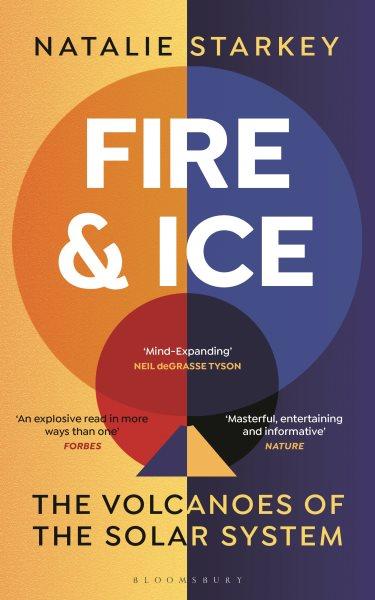
A tour of the Solar Systems tallest, hottest, coldest and weirdest volcanoes and a look inside what makes them erupt. The volcano among the most familiar and perhaps the most terrifying of all geological phenomena. However, Earth isn't the only planet to harbour volcanoes. In fact, the Solar System, and probably the entire Universe, is littered with them. Our own Moon, which is now a dormant piece of rock, had lava flowing across its surface billions of years ago, while Mars can be credited with the largest volcano in the Solar System, Olympus Mons, which stands 25km high. While Mars's volcanoes are long dead, volcanic activity continues in almost every other corner of the Solar System, in the most unexpected of locations. We tend to think of Earth volcanoes as erupting hot, molten lava and emitting huge, billowing clouds of incandescent ash. However, it isn't necessarily the same across the rest of the Solar System. For a start, some volcanoes aren't even particularly hot. Those on Pluto, for example, erupt an icy slush of substances such as water, methane, nitrogen or ammonia, that freeze to form ice mountains as hard as rock. While others, like the volcanoes on one of Jupiters moons, Io, erupt the hottest lavas in the Solar System onto a surface covered in a frosty coating of sulphur. Whether they are formed of fire or ice, volcanoes are of huge importance for scientists trying to picture the inner workings of a planet or moon. Volcanoes dredge up materials from the otherwise inaccessible depths and helpfully deliver them to the surface. The way in which they erupt, and the products they generate, can even help scientists ponder bigger questions on the possibility of life elsewhere in the Solar System. Fire and Ice is an exploration of the Solar System's volcanoes, from the highest peaks of Mars to the intensely inhospitable surface of Venus and the red-hot summits of Io, to the coldest, seemingly dormant icy carapaces of Enceladus and Europa, an unusual look at how these cosmic features are made, and whether such active planetary systems might host life.