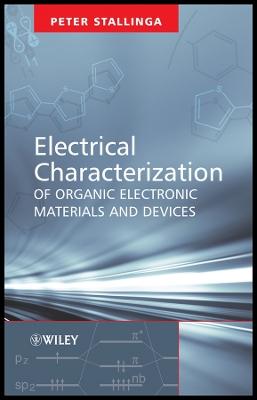
Stallinga (electronics, optoelectronics, and telecommunications; U. of the Algarve, Portugal) primarily reports on his decade of research, and when he mentions a paper, he is not necessarily agreeing with or recommending it, but pointing it out as another stepping stone. For that matter, he says, he does not always agree with or recommend his own findings either, having changed his mind about some fairly major matters in the middle of writing the book. Offering this as an interim report of an ongoing project, then, he discusses two-terminal devices from the perspectives of direct current, admittance spectroscopy, and transient techniques; time-of-flight; and thin-film transistors. Annotation ©2010 Book News, Inc., Portland, OR (booknews.com) Think like an electron Peter Stallinga University of the Algarve, Faro, Portugal Organic electronic materials have many applications and potential in low-cost electronics such as electronic barcodes and in light emitting devices, due to their easily tailored properties. While the chemical aspects and characterization have been widely studied, characterization of the electrical properties has been neglected, and classic textbook modeling has been applied. This is most striking in the analysis of thin-film transistors (TFTs) using thick “bulk” transistor (MOS-FET) descriptions. At first glance the TFTs appear to behave as regular MOS-FETs. However, upon closer examination it is clear that TFTs are unique and merit their own model. Understanding and interpreting measurements of organic devices, which are often seen as black-box measurements, is critical to developing better devices and this, therefore, has to be done with care. Electrical Characterization of Organic Electronic Materials and Devices Gives new insights into the electronic properties and measurement techniques for low-mobility electronic devices Characterizes the thin-film transistor using its own model Links the phenomena seen in different device structures and different measurement techniques Presents clearly both how to perform electrical measurements of organic and low- mobility materials and how to extract important information from these measurements Provides a much-needed theoretical foundation for organic electronics Autorid: Peter Stallinga